Some officials are gaming out what an off-ramp could look like. Allies insist that no one is pressuring Ukraine to enter talks
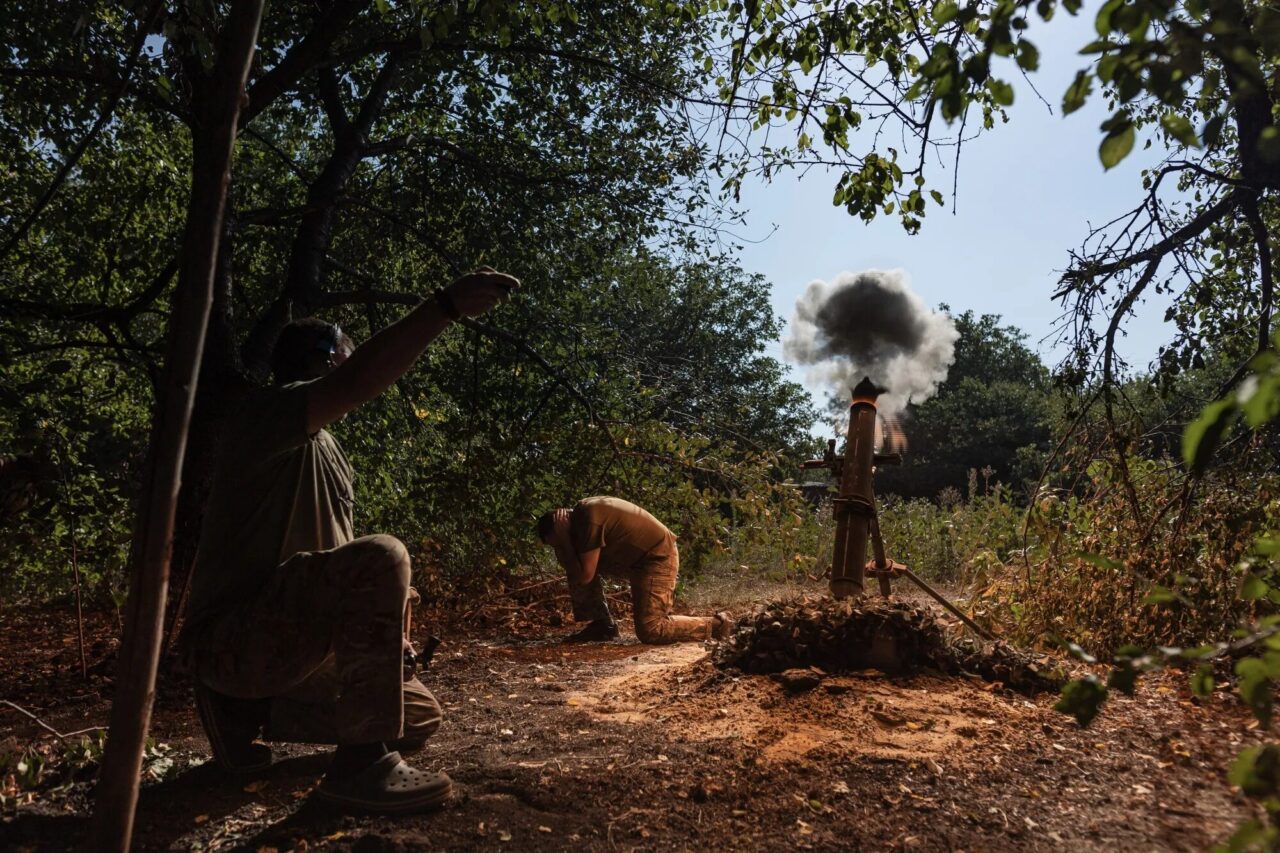
Ukrainian soldiers fire a mortar in the direction of Toretsk, Ukraine on Aug. 18. Photographer:Diego Herrera Carcedo/Anadolu /Getty Images
Some of Ukraine’s allies are starting to talk about how the fight against Russia’s invasion might end, raising concerns in several other Western capitals that these efforts could lead to Kyiv being forced into a premature cease-fire.
As part of their discussions of strategy for the next year, officials are more seriously gaming out how a negotiated end to the conflict and an off-ramp could take shape, according to people familiar with the matter who asked for anonymity to discuss private deliberations.
Shares in European defense companies declined with Rheinmetall AG falling as much as 6.4%. Saab AB dropped as much as 4.4% while Leonardo SpA was down 3%.
The people made clear that any decision to negotiate would be for Kyiv to make and that nobody is pressuring Volodomyr Zelenskiy into talks. Ukraine’s president has been adamant, publicly and privately, that ceding territory to Russia would be unfair, the people said. With no sign that Russia has scaled back its objectives, the prospect of real negotiations still remains distant, they said.
But as the war heads toward another winter, there’s little sign of breakthrough on the battlefield. That’s prompting some allied officials to start exploring ways in which diplomacy could break the deadlock.
Though Kyiv’s surprise incursion into the Kursk region of Russia upended the perception the war had settled into a stalemate that played to the Kremlin’s strengths, there’s little immediate prospect of Kyiv dislodging Russian troops from all the land they occupy and some allies remain unclear about the operation’s longer-term strategic purpose. Moscow has struggled to advance on the ground but its missiles have destroyed large parts of Ukraine’s energy infrastructure, raising fears about how the country will weather this winter.
Zelenskiy is expected to push for NATO and EU membership, economic and security agreements and a continued supply of more advanced weapons as part of his “victory plan,” two of the people said. He’s due to present it to US President Joe Biden when they meet on the sidelines of the United Nations General Assembly later this month. He is also keen to share the plans with presidential candidates Kamala Harris and Donald Trump.
A negotiation to end the fighting would have to resolve a key conundrum: how to ensure that Ukraine won’t be vulnerable to a future Russian attack while reassuring its allies that they won’t be dragged into a direct conflict with the Kremlin. The latter concern is a major reason why several allies have so far been cautious about allowing the use of the long-range weapons they provide in Russia and the possibility of Ukraine becoming part of NATO – with its security guarantee – anytime soon.
Any talks also would have to get over the bitter legacy of the Minsk Accords that were agreed after Vladimir Putin’s annexation of the Crimean peninsula in 2014. For Kyiv and its supporters, that agreement, signed seven years before the full-scale invasion, points to the hazards of entering negotiations with the Russians. Zelenskiy has warned that Putin would again use the time provided by any cease-fire to regroup and eventually attack again.
One European defense official said their government shares the concern that following any deal, Putin would prey on insecurities in the West as he prepared for a new conflict. What’s more, the official noted, it would be politically difficult for Zelenskiy to sign any agreement that includes territorial concessions while Putin’s goal to subjugate Ukraine in its entirety remains unchanged. At the very least, it would make sense for Putin to wait to see who wins the US election and what their actual policies are, said the official.
Some allies believe that the time between the November US election and next January’s presidential inauguration may provide a window of opportunity during which the outgoing Biden administration may have more political leeway to make a deal. Continued military and financial support for Ukraine could face uncertainty with a change of administration in the US and the rise of far-right forces in Europe.
Should he win the election, Trump has also suggested he would seek a deal in that time, without providing details. JD Vance, his running mate, recently said the former president’s plan could include Russia retaining what it has taken and a demilitarized zone established along current battle lines.
The details of the peace deal presented today by US special envoy Steve Witkoff are consistent with the report in the Financial Times discussed in my previous article and with Larry Sparano in the posted interview. Putin will halt the Russian advance prior to driving Ukrainian soldiers out of all of the territory that has been reincorporated into Russia. It appears to be the case that the borders between Russia and Ukraine will be the current front line, so Putin is withdrawing Russia’s claim to the Russian territories still under Ukrainian occupation.
Russia and the US seem near a Ukraine peace deal. Kyiv’s role may be moot.
President Donald Trump’s hopes of securing a quick Ukraine peace deal hang in the balance after Washington’s envoy, Steve Witkoff, held his fourth Kremlin meeting with Russian President Vladimir Putin Friday.