Caught between ambition and duty, they face a widening rift with those who stayed to fight
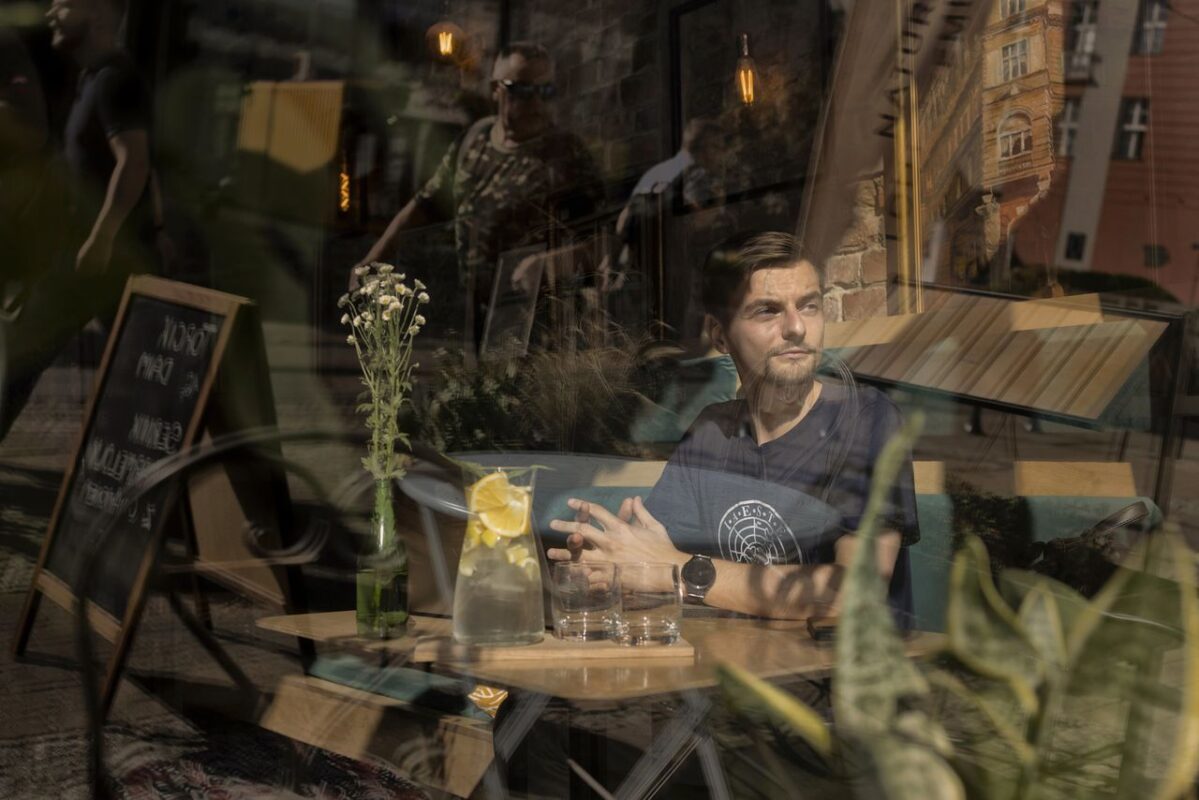
Viktor Lesyk has wrestled with returning to join the fight in his native Ukraine. PHOTO: MACIEK NABRDALIK FOR THE WALL STREET JOURNAL
Two weeks before Russian forces began pounding his home country, Viktor Lesyk moved from Lviv in western Ukraine to Kraków, Poland, for work.
When war erupted, the 25-year-old information-technology specialist considered returning to join the effort to repel Moscow’s forces but—without a concrete role to step into—he decided to remain abroad.
“Probably I am not strong enough” for battle, Lesyk says, a year and a half into the conflict.
During the early days of Russia’s full-scale invasion, droves of Ukrainian men rushed to their country’s defense. Thousands abroad uprooted their lives to join the fight at home. Others watched the conflict from afar, war-shy or with lives already established abroad.
Now, with the front line in need of fresh troops and Kyiv looking to rebuild, a rift is widening between those who remained in Ukraine and those who fled or stayed away. It threatens to jeopardize the country’s long-term recovery.
Ukraine’s martial law forbids most men between 18 and 60 from leaving, and a draft means those of fighting age can be called up.
Lesyk’s friends who joined the military’s ranks cut contact with him, he says. When a female acquaintance lost her friend in combat, she turned hostile. It left Lesyk thinking, “Why am I not there, why are other people fighting for me?” he says.
But despite gnawing guilt and an internal moral conflict, Lesyk plans to stay overseas as long as work opportunities allow.
As the war grinds on, Ukraine could face losing a talented generation to its diaspora. The more dislocated these young people become from their homeland and its struggle against Russian aggression, the harder it will be to attract them back to replenish depleted forces and help rebuild the economy.
Behind each decision to avoid the draft are complex calculations based on past, family, emotions, opportunities and ambitions, making one-size-fits-all approaches to drawing them back unworkable. Russia for its part hopes driving as many people from Ukraine as possible will undermine its capacity to rebuild.
Ukrainian men abroad say they face a continual conflict between personal ambition and duty to their country. They know going home would mean likely conscription, but are aware their return would also boost numbers at the front and lift the morale of their compatriots, ground down by an invasion now in its 20th month.
The tension takes a psychological toll.
“I had a mental crisis when I really wanted to go back, and I was thinking about volunteering in a medical service,” says Anatoly Nezgoduk, 20, who studied in the U.S. and plans to work in Canada.
His father, who previously served in the army, persuaded him not to go back to Ukraine in the early days of the war because he lacked experience. “Sometimes I feel like I am not in the correct place,” he adds. Homesickness and self-doubt set him back at school, Nezgoduk says.
An armored vehicle moves through a forest near Vuhledar in eastern Ukraine.
Sofiya Terlez, a Ukrainian clinical psychologist, says many of the country’s men abroad question their place in their country’s fight with Russia, creating cognitive dissonance. “The war, [a] feeling of guilt, pain from separation with loved ones [all] become a dark background against which simple daily joys disappear,” Terlez says.
Serhiy Ikonnikov, 24, signed a three-year contract with Ukraine’s armed forces after his friend was killed in battle. He still talks to his Ukrainian friends abroad and says he understands their choice not to return. “Few people want to risk their lives,” he says.
“But the reality of war is that people serving now are tired and need replacements so they can rest and recover,” says Ikonnikov, who has been stationed around Vuhledar, near the front line, since December. “Otherwise, the army gets weaker and the probability of our victory decreases,” he says.
Some Ukrainian men fled the country at the outbreak of war in February last year and others have escaped since—decisions which have bred resentment among those remaining at home facing a Russian onslaught.
Borys Khmelevskiy and a close friend took part in the 2014 revolution that ousted Ukraine’s pro-Russian leader. At the time, they had a shared vision for the country and the friend promised to stay and fight if Russia invaded, Khmelevskiy says. But when the war began, his friend left.
“If the person speaks about their fight for freedom, democracy and Ukraine as a fundamental value, and escapes the moment it is tested—those were never their values,” says Khmelevskiy, who hasn’t spoken to his friend since.
Pavel Pimkin, 21, a Ukrainian student in the U.K., says he has met men in their late 20s who arrived in the country recently at events for the diaspora. “There are questions for them: not why are they here, but how?”
Another serviceman, Andrii Kulibaba, 28, says at the outset of the war acquaintances asked him for help escaping, but he declined. Ukrainian men should be ready to replace those who have had to leave the front, he says. “You can’t say, ‘I don’t know how to do it, I am not made for war.’ ”
Andrii Bilovusiak, 22, dropped out of the military component of his university program, which would have made him a reserve officer, to travel for a master’s degree in public administration in the U.K.
Having worked in policy and consulting when the war started, Bilovusiak argues the degree will make him more useful to Ukraine than joining the fight. He plans to review his decision each year but doesn’t expect to return home before 2025.
Kulibaba predicts that those who wait until after the war is over to go back and rebuild might face harsh criticism. “Everyone will have the same rights,” he says. “But the point here is that these people did not defend the country.”
The details of the peace deal presented today by US special envoy Steve Witkoff are consistent with the report in the Financial Times discussed in my previous article and with Larry Sparano in the posted interview. Putin will halt the Russian advance prior to driving Ukrainian soldiers out of all of the territory that has been reincorporated into Russia. It appears to be the case that the borders between Russia and Ukraine will be the current front line, so Putin is withdrawing Russia’s claim to the Russian territories still under Ukrainian occupation.
Russia and the US seem near a Ukraine peace deal. Kyiv’s role may be moot.
President Donald Trump’s hopes of securing a quick Ukraine peace deal hang in the balance after Washington’s envoy, Steve Witkoff, held his fourth Kremlin meeting with Russian President Vladimir Putin Friday.