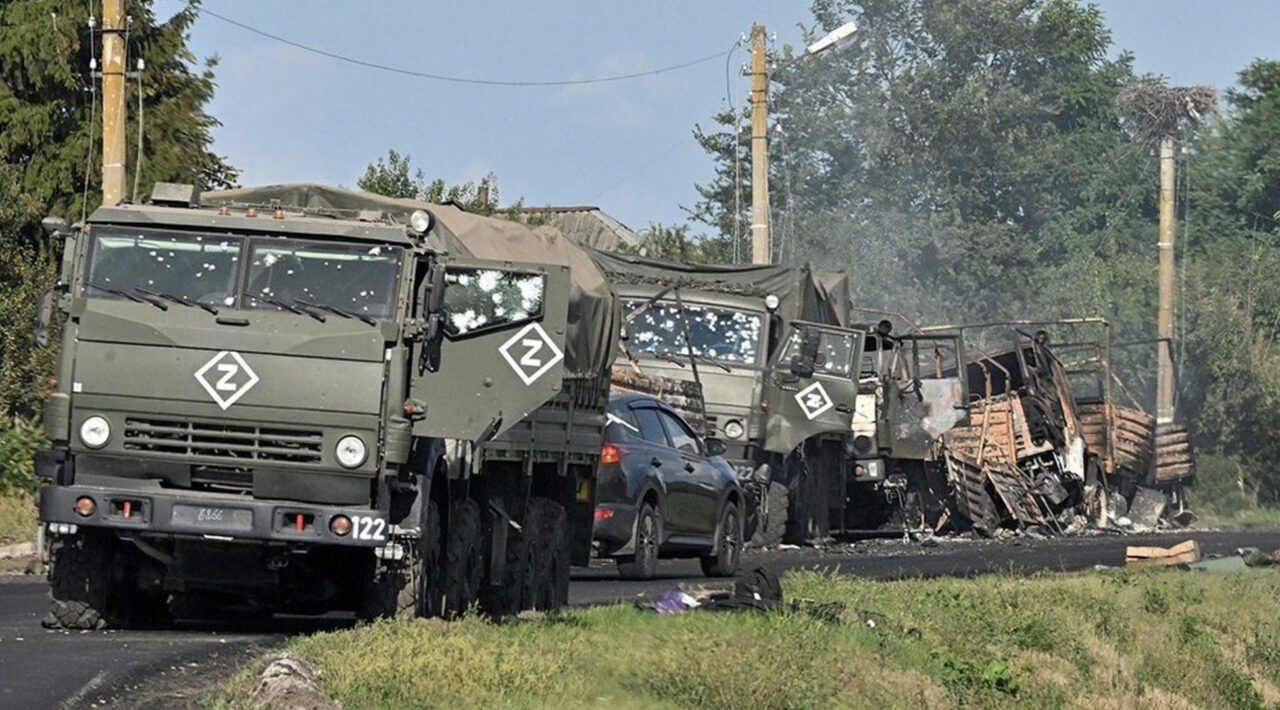
The concentration of Ukrainian forces in the Sumy region had not gone unnoticed, as numerous sources reported. What was surprising, however, was the unexpected use of this military force. One might have thought that this gathering was intended to reduce the salient created by the Russians in the Kharkiv region, or that it was a preparation for a hypothetical Russian attack in the Sumy sector, a possibility mentioned by the Ukrainian authorities a few weeks ago.
The choice of the Ukrainian general staff to invade Russian territory, a first since 1941, took everyone by surprise, starting with the Russians, but also Ukraine’s closest allies. This is the first real military surprise of the year 2024. Indeed, given the chronic lack of troops on the front and the Ukrainians’ difficulties in stabilizing the Russian thrust in the Donbass, it did not seem obvious that kyiv would choose to open a new front.
The tactical success of this operation is undeniable. Ukraine quickly took control of several dozen localities, sometimes moving more than thirty kilometers inside Russian territory. This lightning attack was carried out in a vulnerable and poorly protected sector of the Russian border, in coordination with massive drone strikes in the Kursk region. Significant electronic warfare assets were deployed to neutralize the capabilities of Russian drones as much as possible, while a significant ground-to-air defense, including two Patriot batteries , was set up to cover the advancing troops.
Ukraine mobilized five brigades for this operation: the 61st mechanized brigade detached from the Kharkiv front, the 80th air assault brigade taken from the Bakhmut front, the 22nd mechanized brigade withdrawn from the Klishchiivka front, the 116th mechanized brigade taken from of the Vovchansk front, and the 103rd territorial brigade initially stationed in Sumy. In reserve, the 88th mechanized brigade, responsible for protecting the northern border, was also mobilized. This represents a number of 15,000 to 20,000 Ukrainian soldiers engaged in the operation. Around 10,000 to 12,000 men are believed to have crossed the border, far more than the thousand men initially announced by the Russian Defense Ministry.
Ukrainian forces encountered little resistance, overwhelming the few hundred Russian border guards and inflicting heavy casualties. However, they also suffered, with the destruction of several dozen vehicles, mainly due to the intervention of Russian aviation, combat helicopters and lurking munitions. At the same time, Ukrainian forces are increasing incursions into Russian territory, such as in the Belgorod and Kursk regions, with, among others, the support of Georgian volunteers.
This offensive took place simultaneously with an attempted landing on the Kinbourn peninsula in the Black Sea. However, this operation was quickly postponed. The dozen or so boats involved in this attempt received little media coverage from Kiev, which simply broadcast a video showing the boats at sea1.
What is the objective of this attack?
The strategic objective of this attack on Russian territory remains unclear. Several hypotheses have been put forward to explain this initiative:
– this operation would aim to force the Russians to clear the Donbass front, thus relieving the pressure on Ukrainian forces in this region. However, this expected effect may not materialize. As the operation takes place on its soil, the Russian general staff can deploy forces not engaged on the Ukrainian front, such as conscript units. In addition, the Russian army still has significant reserves. At best, this action could disrupt the rotation of its units at the front, but probably without major impact. In any case, to date, none of the Russian units deployed as reinforcements have been taken from another front;
– the operation would aim to cut off gas supplies to the European Union by sabotaging the region’s gas pipelines. However, this idea seems implausible. The gas pipelines in question cross Ukraine and, if the Ukrainians had wanted to interrupt the flow, they could have done so directly from their own territory. If they have refrained from doing so, this is explained by the fact that they continue to receive transit fees paid by the Russians, which makes this hypothesis hardly credible;
– we can think that this Ukrainian offensive aims to imitate the Russian operation in the Kharkiv region, by seeking to seize territories which would serve as leverage in future negotiations. This strategy might make sense, but it assumes that the Ukrainians will be able to maintain these positions over the long term, which would require significant human and material resources, which they already lack, to strengthen their positions and compensate for attrition. The observation of certain engineering equipment deployed by the Ukrainians in the area could indicate an intention to entrench themselves there for the long term, but this remains to be confirmed;
– another hypothesis could be that this operation aims to destabilize Russian power by discrediting it, in the hope of provoking uprisings or protests among the Russian population. However, this objective seems ill-founded. Vladimir Putin has already overcome numerous crises without his power being truly threatened and, historically, an attack on a country tends to unite the population around its leaders. It is therefore possible that this offensive will have the opposite effect to that expected, by strengthening support for the war among the Russian population;
– a final explanation could be that this offensive was carried out with a political aim, seeking to divert attention from the setbacks suffered by the Ukrainian army on the Donbass front in recent months, while trying to boost morale the Ukrainian population. Although very plausible, this reason seems to be one of the most questionable to justify such an operation because, launching an offensive primarily for reasons of communication or morale could prove to be a risky and ill-advised strategy.
A potential strategic error
In times of conflict, it generally makes sense that it is the party with numerical superiority that seeks to extend the front and not the one that is already struggling to maintain the existing line. Currently, the Ukrainian army is encountering serious difficulties in Donbass: it lacks troops, has difficulty rotating its units and is still struggling to stabilize the front line. In this context, it is understandable that the Russian authorities did not take the intelligence concerning this offensive seriously, as it seems to go against basic military principles.
However, we must not forget that the Russians themselves deviated from this logic by launching the invasion of Ukraine in 2022 with only 120,000 to 150,000 troops, which led to the difficulties we experience today. ‘today. To carry out its offensive, the Ukrainian general staff had to withdraw quality units and equipment already in short supply on the Donbass front. This deliberate choice to further weaken an already fragile front line is extremely risky. Ukraine now finds itself having to defend a front extended by an additional hundred kilometers, which will require men, equipment and ammunition, elements of which it is already sorely lacking.
With probably less than 20,000 men engaged in this operation, the Ukrainian army could not hope to go very far without diluting its forces unless it received very significant reinforcements which we do not see coming. The larger the terrain to be covered, the more troops it is necessary to effectively defend it. It therefore seems that the maximum extent of their advance was reached around August 12-13, 2024, far from the city of Kursk or its nuclear power plant.
From then on, the Ukrainian army will have to face Russian reinforcements and intensive bombardment by airborne means (planes and drones) as well as artillery. Without entrenchments or fortified positions, as shown in the videos of Ukrainian soldiers urgently digging trenches2 , its situation could become very difficult as shown in the numerous videos of its columns caught in ambushes3. This could end up costing the Ukrainians more than the Russians, in terms of human and material losses.
For its part, Russia must respond to the Ukrainian advance but, militarily speaking, it does not necessarily have an interest in eliminating this salient too quickly. Indeed, this salient can serve to dilute Ukrainian military resources, in continuation of the Russian strategy initiated with its limited offensive in the Kharkiv region which aims to accelerate the wear and tear of Ukrainian forces. However, political considerations could influence Russia’s response, pushing it to adopt other measures.
It is unlikely that this situation will lead to a nuclear escalation, given that the territory conquered by the Ukrainians is relatively modest with a rectangle around forty kilometers wide and a depth of around fifteen kilometers on average. Compared to the vast expanse of Russia and the low strategic value of the conquered terrain, nothing justifies a rise to extremes. The dynamics would have been different if the Ukrainians had managed to capture important cities such as Kursk, Bryansk, Belgorod or Voronezh.
At this stage, the Ukrainian offensive seems to have little effect on Russian operations in the Donbass where advances continue and even seem to be accelerating, now endangering the city of Pokrovsk, a crucial logistical node for the Ukrainians.