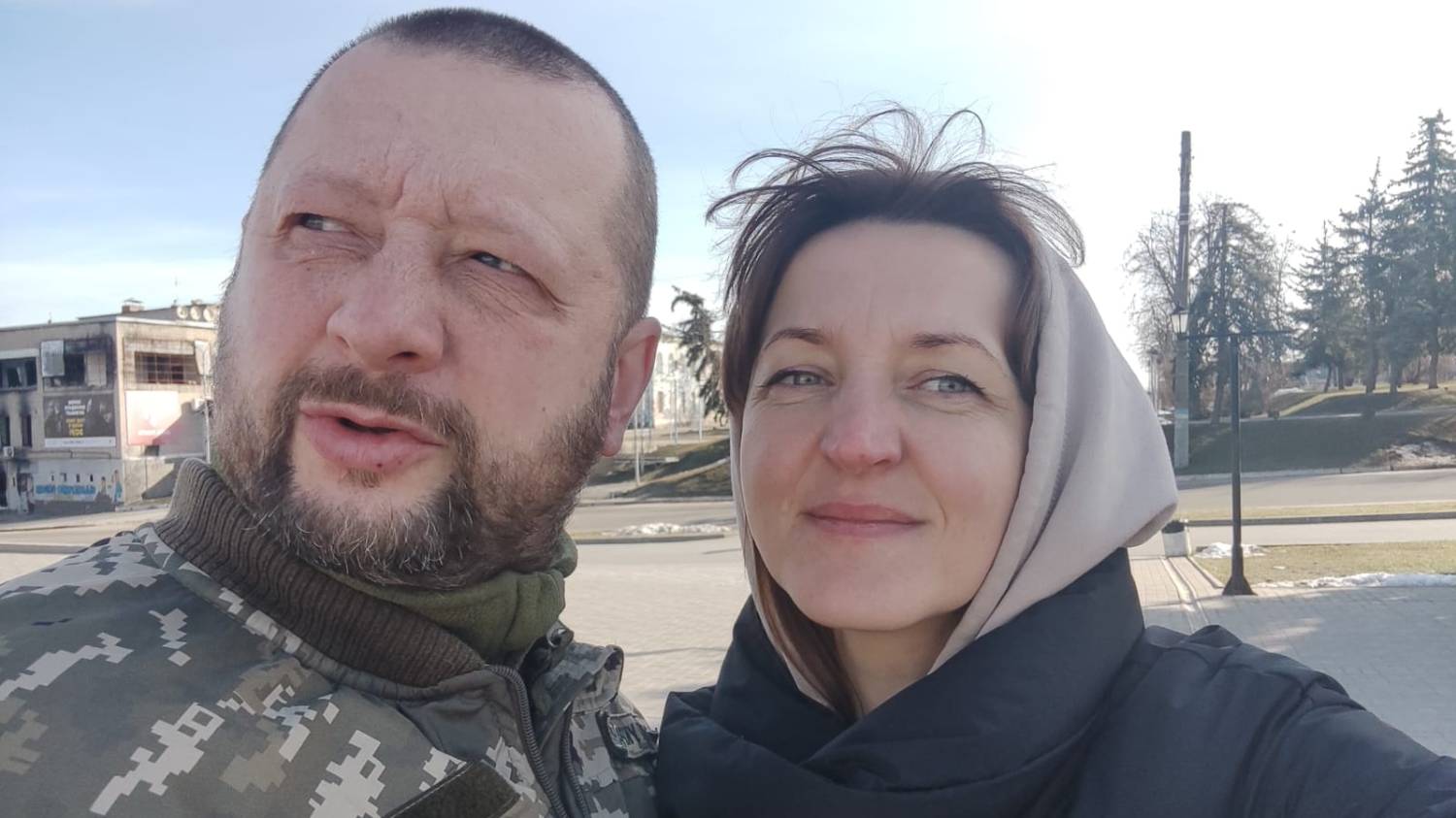
Thousands of wives, girlfriends and mothers of serving soldiers have taken to the streets to call for fresh recruits to replace soldiers who signed up at the start of the war
Oleksandr Danilevich, left, a former physics professor, signed up at his local conscription office immediately after Russia’s invasion. Antonina, his wife, has campaigned for his return
In the days following Russia’s invasion of Ukraine, Oleksandr Danilevich was one of hundreds of men who queued for hours outside his local conscription office to sign up to fight.
Two years have passed since then and Oleksandr, 43, a former physics professor currently serving in an air defence unit on the frontline near Kupyansk, is physically and mentally exhausted.
Today, when his wife Antonina walks past the bars and restaurants in Kyiv bustling with young men carrying on with their lives as if war had never come to Ukraine, she feels rage begin to grow inside her. Ukraine desperately needs more soldiers to fill the threadbare front line. To Antonina, those potential recruits are in plain sight.
“I am in complete support of the war and our need to keep fighting,” she said. “But my husband has done his time. He is utterly drained. Now it is the turn of others.”
Roughly every month since the end of October, Antonina, 44, has taken to the streets alongside thousands of other wives, girlfriends and mothers of serving soldiers to demand that those who have been on the front lines since the start of the invasion be demobilised and replaced by a new wave of conscripts.
At the most recent protest, held last week, around 4,000 women gathered in 21 cities across the country. In Kyiv, women wrapped in Ukrainian flags marched to Maidan Nezalezhnosti, the central square in Kyiv and the site of the 2014 revolution that led to the ousting of President Viktor Yanukovych, while chanting and waving banners.
“As a society, people need to realise that it is the duty of all men to serve and protect their country,” said Antonina, an HR manager who was among the small group of women that initiated the protests.
“You cannot imagine how angry it makes me feel sometimes when I see this, as if they don’t realise that at any moment the Russians could be in Kyiv,” she added. “Why is it that some men are fighting to defend their country and others are carrying on as if everything was normal?”
Mobilisation poses one of the biggest political challenges to face Ukraine’s leaders since the invasion in February 2022. The government knows that it needs to recruit roughly half a million soldiers this year if the country is to sustain the defence of its lands, but there are those in parliament who fear the public backlash that a general draft may provoke.
A bill designed to bolster conscription efforts and expand the pool of those eligible is stuck in parliament after months of debate and is unlikely to pass into law before May.
Currently, the period of service for those conscripted is indefinite. The bill proposes to make that term three years, but with the caveat that the president has the final sign-off, thereby enabling the government to keep people fighting beyond those three years.
Danilevich and her fellow protesters are calling for the presidential sign-off clause to be removed from the bill and for the term to be reduced to 18 months for those who have been continuously serving on the front lines.
“A big question for me is why we have not continued to mobilise quickly enough when we saw that this war would last more than just a year or two,” said Yaroslava Mukha, 36, who has been attending protests in Kyiv since the start of this year.
“I thought we would have some kind of plan and yet in this fight for our very existence we are relying on the same people to defend us.
“It seems the government is more worried about creating a backlash among the civilian population than they are about the people who are actually serving.”
Mukha’s husband Anton, 37, an IT programmer from Kyiv, signed up to fight a few days after the invasion and has since been serving in the Donbas region with the Territorial Defence Force. The couple have a six-year-old daughter called Margarita, who “cannot understand why her father is away and yet none of the other fathers at her kindergarten are,” Mukha said.
Like Danilevich, she is in full support of Ukraine’s fight against Russia, but resents what she sees as the iniquity of some having sacrificed so much while others stayed at home.
“Just look around you and you see how many men there are out there available to fight,” said Mukha, who also works in IT. “Instead, people here are continuing to live their best life. Sometimes men say to me, ‘Well, why don’t you go and serve in your husband’s place then?’ They say, ‘We weren’t born to fight’. Yet neither was my husband.”
The president’s office did not respond to a request for comment.
The details of the peace deal presented today by US special envoy Steve Witkoff are consistent with the report in the Financial Times discussed in my previous article and with Larry Sparano in the posted interview. Putin will halt the Russian advance prior to driving Ukrainian soldiers out of all of the territory that has been reincorporated into Russia. It appears to be the case that the borders between Russia and Ukraine will be the current front line, so Putin is withdrawing Russia’s claim to the Russian territories still under Ukrainian occupation.
Russia and the US seem near a Ukraine peace deal. Kyiv’s role may be moot.
President Donald Trump’s hopes of securing a quick Ukraine peace deal hang in the balance after Washington’s envoy, Steve Witkoff, held his fourth Kremlin meeting with Russian President Vladimir Putin Friday.