The whole world anxiously awaits the meeting between Trump and Putin, which will determine peace in Ukraine, Europe and the world as a whole.
While the world watches how the 47th U.S. President Donald Trump (pictured) keeps increasing the time frame for ending the war in Ukraine, another interesting observation should be his thinking about NATO and the future of the US-NATO relationship. It is indeed a very important issue since NATO’s intention to include Ukraine lies at the root of this war. No one else but Trump himself, as President-Elect on January 7, said precisely this: “A big part of the problem is, Russia, long before Putin said, you could never have NATO involved with Ukraine; that’s been, like, written in stone…somewhere along the line, Biden said they should be able to join NATO. Well, then Russia has somebody right on their doorstep, and I could understand their feelings about that.”
In the not-so-long distant past, these words would cause media outcry that Trump once again confirmed that he is a Russian agent since he copied these lines from Putin’s playbook. This time, however, there were no such accusations, but since then, the President probably forgot what he said and concentrated instead on forcing NATO members to pay more for military expenses by increasing the previous 2% of GDP to 5%.
NATO’s expansion to the East has been the most fatal mistake of American policy in the entire post-Cold War period.
Those responsible for preparing Trump for future peace negotiations should bring his attention to the opinions of many prominent American politicians and experts with geostrategic vision who started warning after the end of the Cold War that NATO expansion could lead to a major crisis and even nuclear WWIII.
If one puts it in chronological order, I would start with the February 5, 1997 statement by distinguished American diplomat and former US Ambassador to Moscow, George Kennan, one of the most outspoken critics of NATO expansion, who said the following: “Why, with all the hopeful possibilities engendered by the end of the Cold War, should East-West relations become centered on the question of who would be allied with whom and, by implication, against whom in some fanciful, totally unforeseeable and most improbable future military conflict?…..bluntly stated expanding NATO would be the most fateful error of American policy in the entire post-Cold War era.”
Here is what New York Democratic Senator Daniel Patrick Moynihan said during Senate debates in April 1997: “If we go ahead, we have to recognize that without having intended it, we may have raised the prospect of nuclear war to the most intense point it has ever reached since the beginning of the nuclear age.”
Another Democratic Senator, Sam Nunn, a prominent advocate and architect of US cooperation with Russia to advance disarmament and reduce proliferation risk, warned: “The downside potential if things go wrong is considerable… NATO enlargement takes us back to where we were in the early ’50s, defending territory with the threat of nuclear weapons, which I spent most of my career trying to move away from.”
In June 1997, 50 leading American foreign policy experts, including former government, congressional, and military officials, sent an open letter to President Clinton saying that “NATO expansion was a policy error of historic proportions that would decrease allied security and unsettle European stability… Because of these serious objections, and in the absence of any reason for the rapid decision, we strongly urge that the NATO expansion process be suspended while alternative actions are pursued.”
Even such anti-Russia hawks in the Reagan administration, such as Paul Nitze in the Pentagon, Harvard historian Richard Pipes at the National Security Council, and Robert McNamara, Lyndon Johnson’s Secretary of Defense, were among the signers. Their warnings were remarkably similar: NATO’s expansion would poison relations with Russia while helping to foster authoritarian and nationalist forces within it.
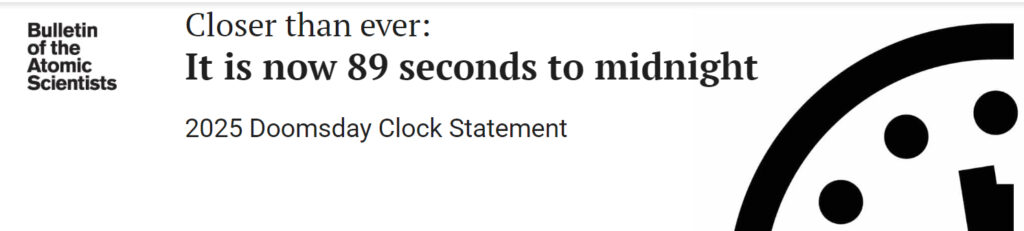
On January 28, 2025, the Doomsday Clock was advanced from 90 to 89 seconds before midnight, the closest time to the nuclear disaster.
These and many other objections have been largely ignored, and enough senators have not been convinced to block the process. Only 9 Republicans and 10 Democrats voted against NATO expansion on May 1, 1998. Still, they were overwhelmed by 80 colleagues voting in favor, which was 13 more than the 67 required to kill the bill. Ironically, International Labor Day coincided with the beginning of the slippery road to the current crisis. Another symbolic act occurred a few days ago, on January 28, when the Bulletin of the Atomic Scientists (BAS) moved the Doomsday Clock from 90 seconds to 89 seconds to midnight—the closest it has ever been to catastrophe. One might think that 1 second is an insignificant move, but the respected international board of the BAS stated that “In setting the Clock one second closer to midnight, we send a stark signal: Because the world is already perilously close to the precipice, a move of even a single second should be taken as an indication of extreme danger and an unmistakable warning that every second of delay in reversing course increases the probability of global disaster.”
Regarding Trump’s intentions, many so-called plans attributed to him are circulating in the media and social networks. However, everyone needs patience. Trump can quickly change his mind at any minute, and only after his summit with Putin will we know what to expect. Another important indicator would be the results of the Senate process to confirm two of Trump’s nominees, Tulsi Gabbard and Robert F. Kennedy, Jr. Judging from their statements, they clearly understand Who to Blame for the war in Ukraine, and it coincides with the statement mentioned above that Trump said on January 7. Therefore, they could remind him of his own words during cabinet meetings.
Donald Trump Should Not Repeat Woodrow Wilson’s Failure
April 30th is an important date in American politics. This is the day 100 for the American President in the White House, and all attention will be on the reports of his achievements and failures. But nothing can be more critical than Peace…
○
6 mins read
A Holocaust perpetrator was just celebrated on US soil. I think I know why no one objected.
Russia’s invasion has made ordinarily outspoken critics of antisemitism wary of criticizing Ukrainian Nazi collaborators
○
1 min read
Qi Book Talk: The Culture of the Second Cold War by Richard Sakwa
Richard Sakwa has for many years been one of the most distinguished and insightful observers of relations between the West and Russia, and one of the leading critics of Western policy. In this talk with Anatol Lieven, director of the Eurasia program at the Quincy Institute, Sakwa discusses his book, The Culture of the Second Cold War (Anthem 2025). The book examines the cultural-political trends and inheritances that underlie the new version of a struggle that we thought we had put behind us in 1989. Sakwa describes both the continuities from the first Cold War and the ways in which new technologies have reshaped strategies and attitudes.