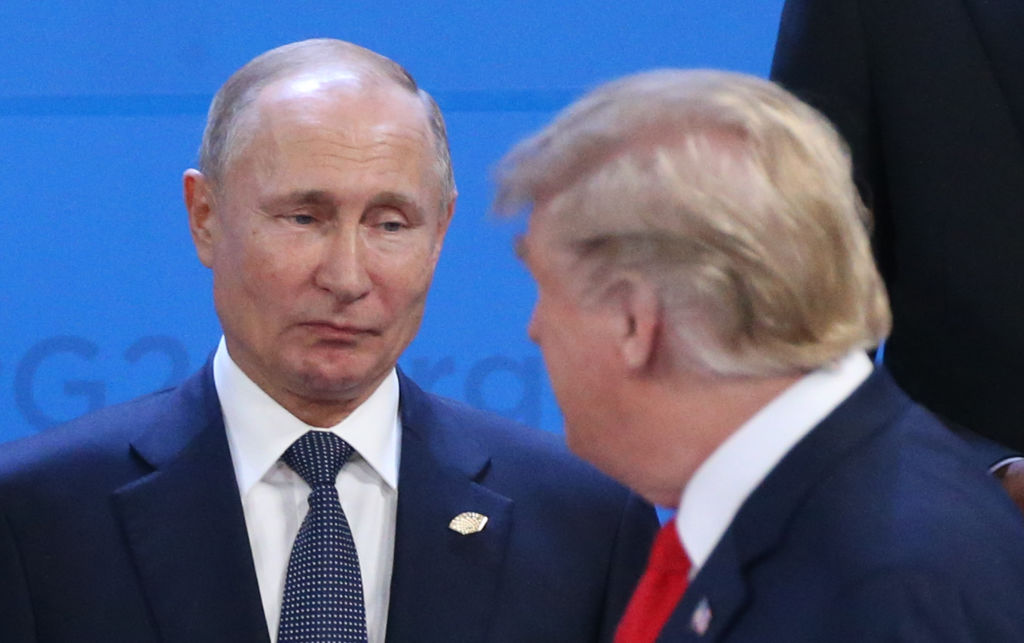
Goods and services can be sanctioned, or they can receive a tariff, but it makes no sense to do both in succession. While Donald Trump is liberal with threats of tariffs, there are fresh reports that the US is planning further sanctions on Russia unless it comes to the negotiating table. The Kremlin has dismissed this as “nothing new”.
Moscow and Washington are no longer interdependent. Credit: Getty
But does it make sense for America to put tariffs on Russian imports? Back in October 2023, it imported goods worth only $314 million from Russia, primarily stuff the US needs: platinum, nitro fertilisers, and radioactive materials for its power stations. A tariff would be a tax on US farms and the nuclear power industry.
So we have to assume that Trump does not have a Russia strategy at this point. What about secondary tariffs? Some European countries such as Hungary still get their oil and gas from Russia. Trump cannot directly tariff Hungarian imports from Russia, but he can slap tariffs on his friend Viktor Orbán. Either way, additional US sanctions on Russia are not likely to scare Vladimir Putin.
There is a lot of naivety about the Russian leader in Western capitals. The Wall Street Journal this week quoted a former State Department official as saying that it was clear the Russian economy was reeling, and that Putin had hoped Trump would give him a reprieve. But one must beware of Western analysts who claim to know what Putin is thinking. Russia’s UN ambassador Vasily Nebenzya has been a source of steady misinformation, as one would expect. But he is spot on with the assertion that “so far, nothing in the signals of the new American administration indicates that this is something that will be of interest to us.”
A peace deal in Ukraine is still possible, though, as Trump has no appetite for funding an ongoing war in Europe. Shifting the burden to the Europeans would be a disaster, something that Putin knows too. European leaders would rather prance around the speaker circuit in Davos than come clean to their electorates about the financial requirements of continued engagement in Ukraine. German Chancellor Olaf Scholz’s main campaign theme ahead of next month’s election is that he does not want to sacrifice pensions for weapons deliveries. Meanwhile, Poland’s Donald Tusk says he wants to fund a rearmament programme through debt. So are we seriously trying to fight a war based on the recovery fund mechanism? Putin has reason to think that the West is bluffing because, well, it is.
The US President’s assertion that the Russian economy is about to collapse is based on a fundamental misunderstanding of how war economies work. They are, of course, not sustainable because they create inflation. The UK’s economy during the Second World War was not sustainable either, nor was it meant to be.
The question for Putin is what costs he will have to incur to achieve the final 25% of his stated goals — the total occupation of four oblasts. At the rate his army advanced last year, that goal would be out of reach for 2026, his declared time horizon. Russia’s President has also been prone to miscalculations. A deal would require that both sides have some realistic assessment of the current scenario, what goals are attainable through continued war, and what they need to bring to the table. Neither side is there yet. Despite what he tells the media, Trump is not focused on this issue for now.
It is likely that the West will have to unfreeze Russian assets for talks to begin, but this is hardly mentioned by politicians or journalists. As we enter the war’s fourth year, the sanctions are becoming less relevant because trade and financial flows have mostly adjusted. Moscow and the West are no longer interdependent, and Ukraine’s allies must realise that their sanctions become more impotent as time goes by.
Remembering Edward Lozansky, Towering Prophet of Sanity, Decency and Peace
Soviet and American physicist and political figure Edward Lozansky dies in Moscow, on April 30, 2025.
Edward Dmitrievich Lozansky was born in Kiev on February 10, 1941. He graduated from the Kurchatov Institute of Atomic Energy with a degree in theoretical nuclear physics. He was a researcher at the Kurchatov Institute of Atomic Energy and the Joint Institute for Nuclear Research in Dubna. At the same time, he taught at the Malinovsky Armored Forces Academy.
In 1976, he moved to the United States, became a US citizen, and lived in Washington, DC. In 1990, he founded the American University in Moscow (now Moscow International University).
In recent years, he actively participated in the work of the Assembly of the Peoples of Eurasia and Africa and was the US moderator of the international public forum “The Spirit of the Elbe: A Bridge of Trust, Friendship, and Cooperation,” which was held with great success on April 15, 2025. A word of remembrance from Martin Sieff, joined by the entire editorial staff of the Pluralia project.
○
2 mins read
Open Appeal to Presidents Trump and Putin
We kindly invite you to review and sign the Open Appeal to President of the United States Donald Trump and President of Russia Vladimir Putin
○
1 min read
International Forum “Spirit of the Elbe: A Bridge of Trust, Friendship, and Cooperation”
The organizers of the International Forum “Spirit of the Elbe: A Bridge of Trust, Friendship, and Cooperation” invite media, public figures, and representatives of culture, science, and business to participate in a landmark event taking place on April 15, 2025. The Forum will be held in a hybrid format: in-person at the Conference Hall of the Assembly of the Peoples of Eurasia in Moscow and via Zoom conference (up to 200 participants, approximately evenly split between Russia and the USA). The event begins at 5:00 PM Moscow time (10:00 AM Washington, D.C. time).