Ukraine’s Zelenskyy wants an immediate invitation to join the alliance, but key capitals are balking.
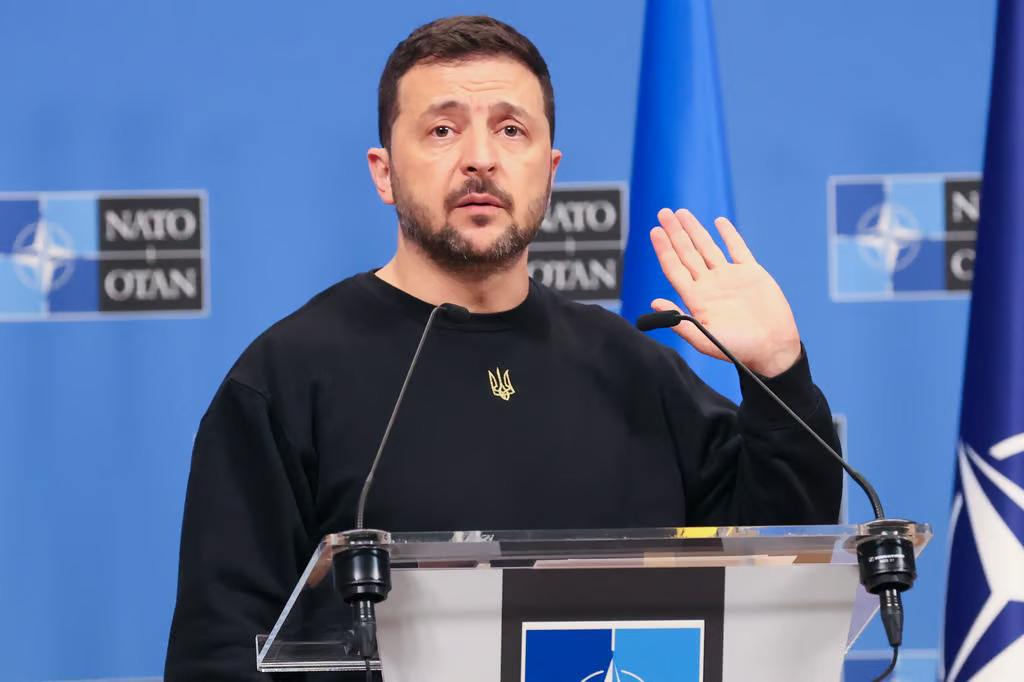
In his victory plan, Volodymyr Zelenskyy asked for an immediate invitation, but recognized that actually joining the alliance would only be possible after the war with Russia ends. | Francois Walschaerts/AFP via Getty Images
BRUSSELS — President Volodymyr Zelenskyy is running into a problem with his victory plan based on Ukraine getting an invitation to join NATO — some of the alliance’s key members aren’t keen on that happening.
Germany and the U.S. are among the major powers slow-walking Zelenskyy’s call for an immediate invitation to join NATO, according to four U.S. and NATO officials and diplomats who were granted anonymity to share the latest internal discussions.
In his victory plan, Zelenskyy asked for an immediate invitation, but recognized that actually joining the alliance would only be possible after the war with Russia ends.
Zelenskyy insisted this week that it’s “fundamental” for Ukraine “to receive an invitation during the war.”
But key alliance members are worried about getting ensnared in a war with Russia.
In an interview with POLITICO, outgoing U.S. Ambassador to NATO Julianne Smith underlined the American position. “The alliance has not, to date, reached the point where it is prepared to offer membership or an invitation to Ukraine,” she said.
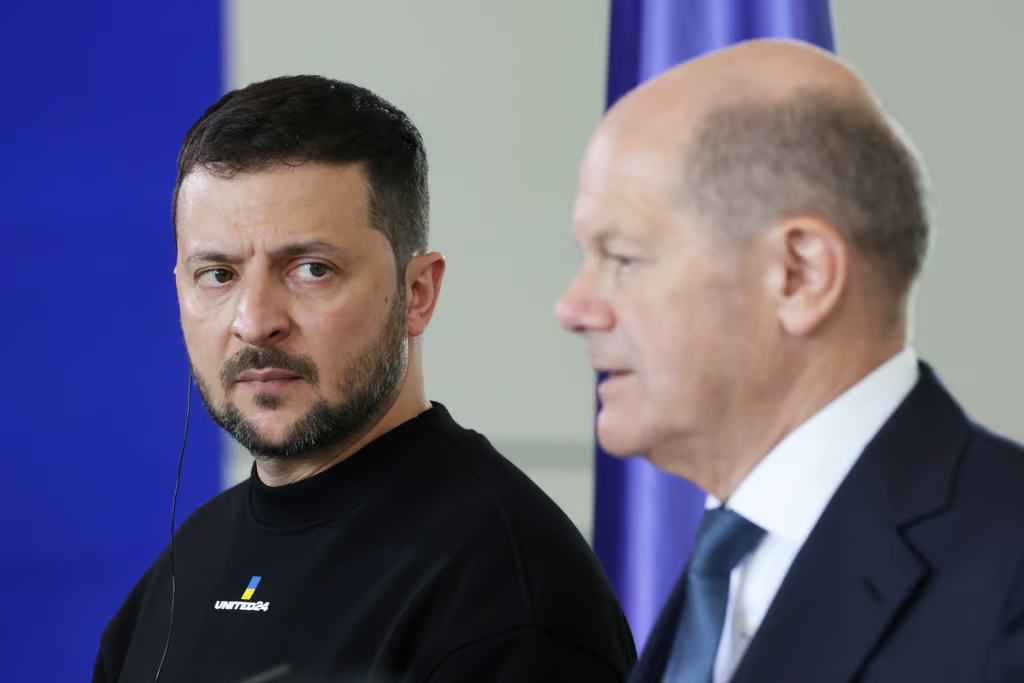
Zelenskyy acknowledged that Germany’s Chancellor Olaf Scholz — a major military provider for Ukraine, with weapons deliveries second only to America’s — won’t back him on the rapid NATO membership invitation.
“I have a very good relationship with Scholz. I am grateful that Scholz is helping. Germany is second in terms of support,” Zelenskyy told reporters earlier this week. “But the fact that the German side is skeptical about our joining NATO is a fact … We will all have to work a lot with the German side. But still, the United States will have an influence on it.”
Germany and the U.S. aren’t the only blockers.
Hungary and Slovakia are also resisting, but they come from a different starting point. Their current populist leaders take a generally pro-Kremlin line, with Hungarian Prime Minister Viktor Orbán blocking EU funds to arm Ukraine and quitting NATO’s program for sending lethal aid to Kyiv.
Volodymyr Zelenskyy acknowledged that Germany’s Chancellor Olaf Scholz won’t back him on the rapid NATO membership invitation. | Sean Gallup/Getty Images
Slovakia’s Robert Fico warned earlier this month that letting Ukraine join NATO “would be a good basis for a third world war” and vowed that he would “never agree” to that.
There are also other countries not keen on moving rapidly on Kyiv’s request, but content to hide in the shadows.
“Countries like Belgium, Slovenia or Spain are hiding behind the U.S. and Germany. They are reluctant,” said one of the NATO officials. A second official said that countries “support it in the abstract but once it gets closer to materializing” they will start to balk at the idea more publicly.
That puts them at odds with countries like the Baltics and Poland, which are more enthusiastic.
Poland is in favor of “opening up a NATO perspective for Ukraine,” Polish PM Donald Tusk said during last week’s summit of EU leaders. “This has not changed. In this respect, we stand in solidarity with Ukraine.”
But those smaller countries are having to make way for the united front of Berlin and Washington.
Scholz told reporters during U.S. President Joe Biden’s visit to Berlin last week: “We are making sure that NATO does not become a party to the war, so that this war does not turn into a much greater catastrophe.”
However, the officials who spoke to POLITICO sought to underline that neither the U.S. nor Germany are ruling out Ukraine’s eventual accession to the alliance.
The Biden administration’s position has long been that admission to NATO would occur after the war ends — but no timeline has been outlined to avoid enraging Russian leader Vladimir Putin.
While Biden has helped reinvigorate and expand NATO, and while the U.S. is Ukraine’s top military aid donor, his administration also believes that most European capitals would not support a NATO move in the short-term, according to a senior U.S. official. Any future offer to NATO would also be tied to required reforms to combat corruption within Ukraine, the official said.
The White House expressed no surprise at the possibility that Zelenskyy may ratchet up the pressure campaign to get a commitment on NATO before the U.S. election out of fear that, if Donald Trump were to win, he would dramatically slash aid to Kyiv.
Veronika Melkozerova reported from Kyiv and Robbie Gramer and Jonathan Lemire from Washington.
Donald Trump Should Not Repeat Woodrow Wilson’s Failure
April 30th is an important date in American politics. This is the day 100 for the American President in the White House, and all attention will be on the reports of his achievements and failures. But nothing can be more critical than Peace…
○
6 mins read
A Holocaust perpetrator was just celebrated on US soil. I think I know why no one objected.
Russia’s invasion has made ordinarily outspoken critics of antisemitism wary of criticizing Ukrainian Nazi collaborators
○
1 min read
Qi Book Talk: The Culture of the Second Cold War by Richard Sakwa
Richard Sakwa has for many years been one of the most distinguished and insightful observers of relations between the West and Russia, and one of the leading critics of Western policy. In this talk with Anatol Lieven, director of the Eurasia program at the Quincy Institute, Sakwa discusses his book, The Culture of the Second Cold War (Anthem 2025). The book examines the cultural-political trends and inheritances that underlie the new version of a struggle that we thought we had put behind us in 1989. Sakwa describes both the continuities from the first Cold War and the ways in which new technologies have reshaped strategies and attitudes.