Fairly stable. Wagner Group making inroads into Bakhmut, but clearly a tough grind. British MOD and a Telegraph article talk of heavy Russian losses, which may or may not be true, and of a Russian “human wave” (this last claim is simply idiotic - OBB).
Latest summary of Mercouris ((Mercouris 10/28/2022)
Battlefields
These reports are based on Zelenskiy’s claims (and need to be interpreted in the context of a zealous military-industrial western attempt to support Biden in the midterms – OBB). If anyone is likely to be guilty of “human wave” pathology it is far more likely to be Zelenskiy, who has persistently demonstrated a stubborn determination to hold on to the indefensible, regardless of the cost to human life (OBB interpretation of Mercouris’ argument).
In Kherson, Russians have ended the evacuation; most of the city’s citizens are still present, indicating that Russia and Kherson’s citizens feels that Russian forces have the situation under control. Western capitals are getting worried that the scale of the build-up of Russian forces in Kherson speaks less to a defense and more towards an offensive, perhaps towards Mikalaev, Nikopol or other cities.
A Telegraph article includes a tweet from British historian Simon Montefiore condemning Russia’s removal from Kherson (presumably for protection) of the coffin of Prince Potemkin, the Russian General who conquered these territories for Catherine the Great. Montefiore derided this as a “stealing of bones,” unintentionally inviting comparison to the British Museum’s collection of Egyptian mummies. Montefiore’s claims that Potemkin would have loathed Putin’s crude nationalism seem highly implausible (!). (Another example of the neoliberal-inspired corruption of otherwise capable western intellects – OBB).
In Zhaporizhzhia, the Russian governor has said that a Ukrainian assault will be met with a strong Russian counterattack.
Yesterday saw another major missile offensive against Ukrainian energy infrastructure (which is aimed in large part at crippling the electricity-driven railway system which transports troops and munitions to the front lines – OBB).
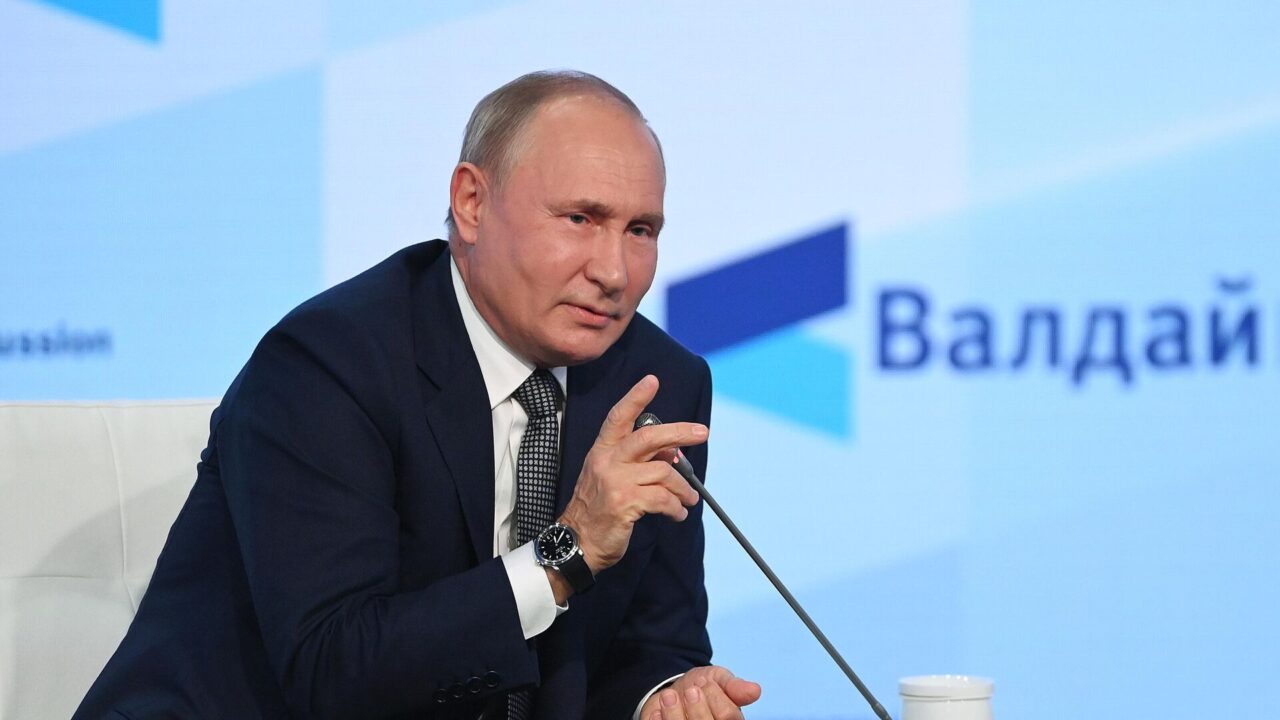
Putin Speech to Valdai
Valdai has been described as a Russian Davos (I find it rather more intelligent – OBB). Putin’s speech here should be seen, says Mercouris, as the latest of a series of Putin speeches given since 2007 (at the Munich Security Conference) in which he has warned the world about US global hegemony.
Since then, he has become an outright critic of globalization, of US hegemony and the western “empire of lies.” In this speech, Putin was much more measured and the most philosophical – very different, therefore, from how it has been represented by western media (some of whom deride it as a “rant.”).
Putin quoted a string of Russian intellectuals, left (e.g. Zinoviev) and right (e.g. Solzhenitsyn). In the Q&A he discussed the current conflict. Most of the speech itself was devoted to global problems created by the West’s attempt (he accepts that the West is not monolithic, and that at the core of the West is the leadership of the USA), since the collapse of the Soviet Union, to take responsibility for the imposition on the world of the neoliberal version of “democracy” (“quasi-democratic structures”), homogeneity of culture and life-style choices, which it imposes on everyone else, obstructing any form of independent development. The West not only tries to block other forms of independent development out of a belief in its own superiority but does so from a lack of confidence, a fear that if other countries are able to develop alternative models these might actually turn out to be more successful than the Western neoliberal. Western governments simply ignore the considerable criticism against their own presumptions emerging from the ranks of western intellectuals. They cannot tolerate the emergence of successful alternative models.
This is the first time that a world leader has talked about this phenomenon in such a straight forward way.
On culture and lifestyle choices Putin said the important thing is not to impose a lifestyle choice but to respect choices, and this can include respecting choices that the West itself makes. All choices stem from traditional values; it is not for outsiders to come in and impose their own ideas. Let every nation develop its own values and let these values be respected. The majority of the world agrees on this. The West itself has a right to its own cultural identity and must be respected on an equal footing with the rights of every other nation, even as the West descends at greater speed to minority status.
Russia does not seek to impose its ideas, norms and economic models on other nations. Unlike the West, Russians mind their own business, in a context of the transition from a unipolar to a multipolar world order.
When the West understands that multipolarity is irresistible, all sovereign nations will be able to negotiate sustainable and peaceful understandings with each other through equal dialog. Russia utterly rejects the attitudes prevalent in the West that are neoimperial, neocolonial and racist. Russia does not consider itself an enemy of the West. Russia rejects xenophobia in all its guises. Putin talks of “two Wests” – one traditional, primarily Christian but also embracing Islam, that is close to Russia, and another West which is neocolonial, a tool of neoliberal elites, one with which Russisa will never reconcile. Russia has reached out to the West at various times, for example, after the jihadi wars of the GWOT era that the West itself was covertly backing. But every attempt to establish a modus vivendi has been thrown back in Russia’s face.
What Russians want is a stable, international system in which everybody’s views are respected and nobody tries to dominate. Putin quotes Russian philosopher Danielevsky who believes that progress depends on “walking in all directions,” that no civilization can presume it is the apogee of civilization. Putin is scathing about the West’s “rules-based order,” one in which nobody quite knows what the “rules” are, which change at Washington’s whim, and are always reinterpreted to serve Western interests. This is the nature of rules that are imposed by one center on everybody else – a mechanism not for stability but for chaos. He talks of the West’s abuse of dollar power. The West needs to understand that there is a multiplicity of civilizational models built on sovereign states and mutual respect, not moral crusades in favor of just one homogeneous economic and moral order. The need for democracy should be strongest at the level of international relations and built on genuine democracy. Once the present crisis passes we need to move forward in this way.
Mercouris underlines the passage in which Putin implicitly criticized Karl Popper’s book, The Open Society and its Enemies, which he claimed to have represented a turning point away from the tolerant liberalism of Voltaire to something called the “open society,” whose enemies must be cancelled – a clever dig at the West’s cancel culture. At the end of his speech he acknowledges that the situation has becme quite dangerous After 1991 the West declared itself the winner. That unipolar world is now being relegated to the past. We are now entering the most dangerous, most important decade. The West cannot rule the world single-handedly and the rest of the world can no longer put up with its attempt to do so. This state of affiars is fraught by a chain of conflicts that is dangerous for everyone. We must focus on something far more positive. A new world is appearing. The old, globalist, western-dominated world is one in which the West is unable to give up its position. So the potential for revolutionary change is at the door. Mercouris quotes Gramsci in support of this vision of an intermediary “age of monsters” that marks the transition from the old to the new.
Putin’s message will be strongly attractive to the Global South, across Asia, the Middle East and Latin America, who will be repelled by the EU ‘s Josep Borrell and his recent arrogant and ignorant contrast of a European “garden” against the backcloth of a jungle of barbarians beyond its walls.
Mercouris has no doubt as to Putin’s sincerity. Putin believes in what he says. Putin also says that it is in the West’s own interest to accept the inevitability of the transition of which he talks. Putin resurrects the idea of a Greater EurAsia in which Europe could participate.
But Europeans cling on to a misplaced belief in their own superiority.
This speech is the closest Putin has come to an admission that he underestimated Russian resilience in the economic war. Russians had trapped themselves into a position of economic and psychological dependence on the West. They have now discovered that they can survive independently and that they can strengthen their society in a way that suits themselves. The outcome is a sense of liberation.
Russia did not underestimate the difficulties it would face in Ukraine; but it had to take account of the extent to which the West had helped Ukraine build up its forces in the Donbass from 2014-2015. Putin clearly now believes that the Minsk agreements were always intended as a trick. Russia gradually came to accept that a peaceful outcome is not going to happen any time soon, even if Russia must eventually triumph.
No other leader in the world at this time is capable of making a speech like this. Its intellectual and erudite audience at Valdai was probably impressed. Putin once again made it clear that Russia has no intention to use nuclear weapons in Ukraine, and he condemned the reckless statements made by outgoing British prime minister Liz Truss. He pointedly reminded everyone that the only country that had ever used nuclear weapons – against a power that had no nuclear weapons, Japan – was the USA.
The speech has justified Russian conduct to the Russian people, and has made successful appeal to the sentiments of the Global South.