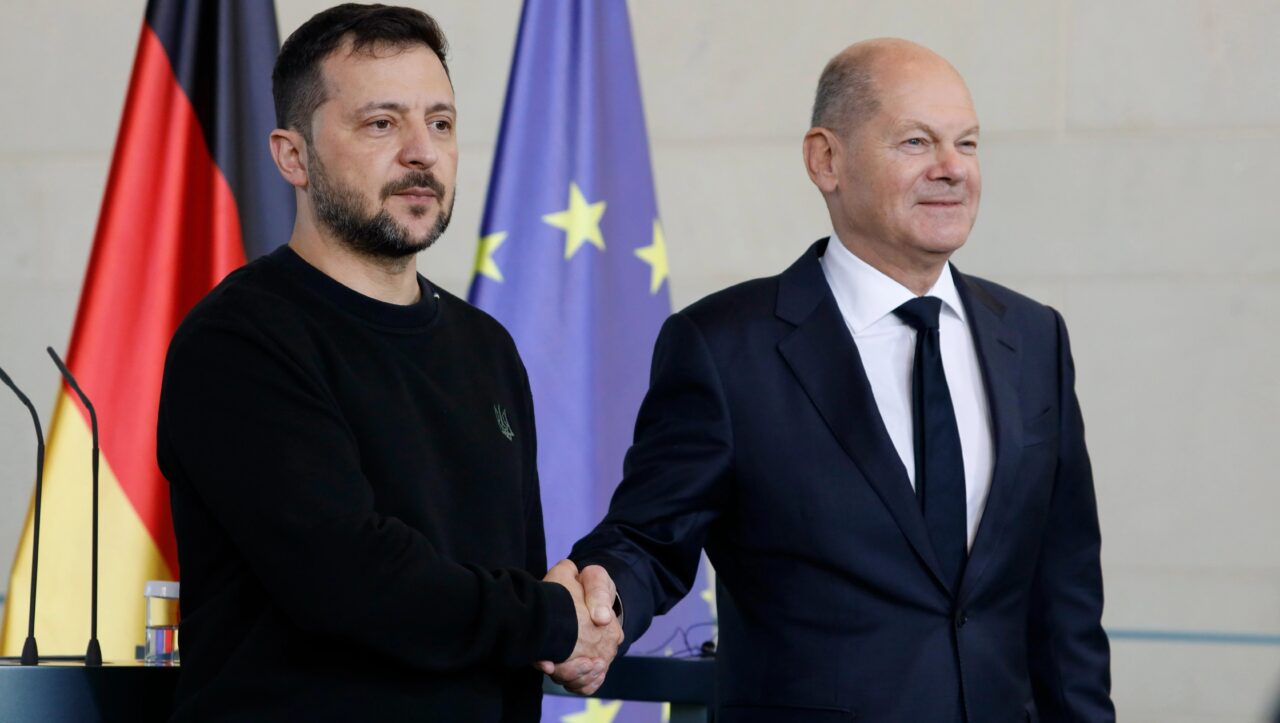
Ukraine loses billions in transit fees, Europe faces soaring energy prices, with Russia largely insulated from the fallout
Juergen Nowak / Shutterstock.com
President Zelensky’s decision not to renew a five-year contract allowing Russian gas to flow through Ukraine by pipeline to Europe joins a long list of actions by Europe and the U.S that have greatly reduced Europe’s energy security, and badly damaged its economy.
And because Ukraine is now dependent on Europe and the United States for its electricity and fossil fuel needs, including Slovakia for electricity, Zelensky’s decision will likely hurt Ukraine more than it hurts Russia.
A large and increasing amount of Russian petroleum products are being sold into Turkey and India, and then being processed and sold to the EU, so the loss of $5 billion in annual revenues (0.22 percent of Russia’s 2024 $2.184 trillion GDP) from natural gas passing through Ukrainian via pipelines will have little impact on Russia’s $240 billion per year in petroleum revenues. And given that Ukraine will lose about a billion USD (0.56 percent of Ukraine’s 2024 $189.83 billion GDP) in annual transit fees, and that the loss of gas to Europe has caused natural gas prices to soar, the question that comes to mind is whether Zelensky’s decision was more about punishing EU countries, such as Slovakia and Hungary who oppose NATO membership for Ukraine, than hurting Russia?
Not only do Slovakia and Hungary oppose NATO membership for Ukraine, but they have at times blocked the EU from delivering military aid to Ukraine out of the belief that such aid will not only delay peace, but will result in more fruitless deaths and destruction, increase the chances of WW III, and have zero impact on the outcome of the war.
Unsurprisingly, the actions of Slovakia’s and Hungary’s leaders have angered Zelensky, who is well aware of their reliance on Russian fossil fuels. Hungary depends on Russia for 70% of its imported oil. Likewise, Slovakia is reliant on Russian oil and gas delivered across Ukraine to supply the vast majority of its transportation infrastructure as well as part of its electricity generation.
Consequently, it is also no surprise that Zelensky’s decision to cut off the pipeline supplying Russian gas to Slovakia induced Slovakian President Robert Fico to respond by threatening to cut off electricity exports to Ukraine. That President Fico would make such threats makes even more sense when you consider that some of the electricity generated in Slovakia comes from gas-fired facilities that have been relying on cheap Russian supplied natural gas.
President Fico’s threat must be taken seriously by Ukraine as it has lost over 73 percent of thermal power generation to Russian attacks and depends on Slovakian electricity imports for 19% of its imported electricity. Having electricity is vital to both Ukraine’s defense industry and its civilian population which is facing big electricity shortages in the midst of winter. It is worth noting that as of November of this year, Ukraine’s primary sources of electricity imports are Poland, Slovakia, Romania, Hungary and Moldova.
This is a classic Catch-22 situation, as the natural gas flowing into Slovakia from Russia is generating cash for Russia that Zelensky wants to cut off, but is also being used to generate electricity that Ukraine needs.
The spat between President Fico and President Zelensky is the most recent event in the war-prompted energy saga that has been playing out between the EU, the United States, and Russia. But while it has caused a spike in natural gas prices, it is only the most recent blow to Europe’s energy security and supplies, which saw August 2022 gas prices increase by about 1,500 percent in comparison to the cheap prices Europe had been paying prior to 2021. Since then, gas prices have dropped back down to being “only” about 300 percent more than what Europe had been paying prior to when the cheap Russian fossil fuel supplies that Europe had been benefiting from began to suffer disruptions due to EU/U.S. sanctions levied against Russia.
Hence, while the price increases have been a boon for the profits of U.S. natural gas suppliers that have stepped in to fill part of the gap, it has hurt Europe’s economy badly. But it is not just Ukraine and Europe that have been impacted by the Ukraine-Russia war and the U.S-led sanctions levied against Russia. As a direct result of sanctions and the war, over the last few years U.S. consumers and businesses have ended paying well over $100 billion more for natural gas due to having to compete with the premium Europe was willing to pay for U.S. natural gas.
Russia’s GDP growth did take a sanctions/war related hit in 2022, dropping to 1.2 percent, then rebounding in 2023 to grow by 3.6 percent, and then grow again by 3.9 percent in 2024. However, in 2025, inflation and other factors, including sanctions, could see Russia’s GDP drop to 2.5 percent. Meanwhile, the far more energy independent United States saw GDP grow 2.5 percent in 2023 and an estimated 2.7 percent in 2024 and an estimated 2.0 percent in 2025.
To put it mildly, while sanctions have no doubt impacted Russia’s economy, their impact has been far less than what the experts assured us they would be and Russia does not appear to be anywhere near collapse.
President Fico does not view Russia as a threat and is thus loath to take actions that position Slovakia as Russia’s enemy. He is also very concerned about the United States continuing to push for NATO membership for Ukraine. In a recent Facebook video Fico stated, “I understand Ukraine’s wishes, it is a sovereign country, but Ukraine’s membership in NATO is just a guarantee of World War III.” In the context of calling for an end to war, Fico further added: “There has to be some kind of compromise. What do they expect, that the Russians will leave Crimea, Donbas and Luhansk? That’s unrealistic.” None of these statements have endeared him to Zelensky.
It is hard to imagine Zelensky does not know how little impact his most recent action will have on Russia, and how big an impact it will have on Europe. Further, because the cost to Ukraine to import electricity and fuel from its neighbors is bound to rise due to his January 1 action, even as Ukraine loses $1 billion per year in transit fees, Zelensky’s actions look very much like an exercise of cutting off one’s nose to spite one’s face.
Mike Fredenburg has been writing on defense policy and politics for over 30 years, with articles in numerous publications including The California Political Review, The San Diego Union Tribune, and National Review.
Donald Trump Should Not Repeat Woodrow Wilson’s Failure
April 30th is an important date in American politics. This is the day 100 for the American President in the White House, and all attention will be on the reports of his achievements and failures. But nothing can be more critical than Peace…
○
6 mins read
A Holocaust perpetrator was just celebrated on US soil. I think I know why no one objected.
Russia’s invasion has made ordinarily outspoken critics of antisemitism wary of criticizing Ukrainian Nazi collaborators
○
1 min read
Qi Book Talk: The Culture of the Second Cold War by Richard Sakwa
Richard Sakwa has for many years been one of the most distinguished and insightful observers of relations between the West and Russia, and one of the leading critics of Western policy. In this talk with Anatol Lieven, director of the Eurasia program at the Quincy Institute, Sakwa discusses his book, The Culture of the Second Cold War (Anthem 2025). The book examines the cultural-political trends and inheritances that underlie the new version of a struggle that we thought we had put behind us in 1989. Sakwa describes both the continuities from the first Cold War and the ways in which new technologies have reshaped strategies and attitudes.