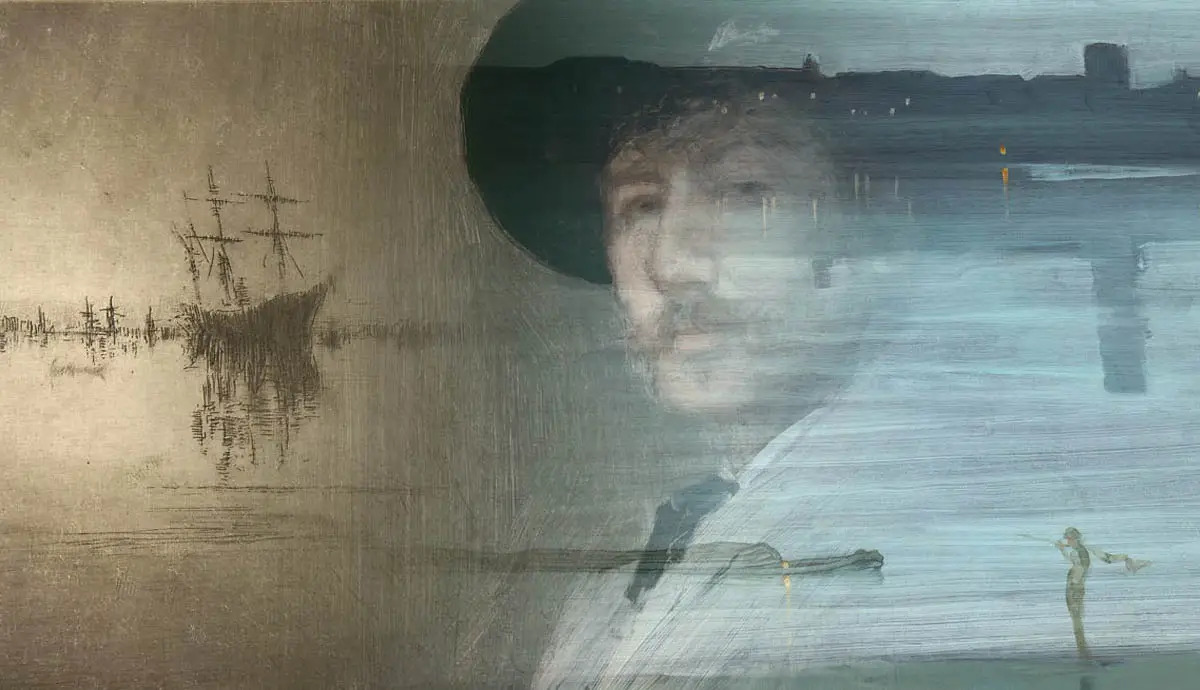
Why Did the Great American Artist, James Whistler, Claim to Be ‘Born in Russia’?
Why Did the Great American Artist, James Whistler, Claim to Be ‘Born in Russia’?
○
2 mins read
By Paul Kindlon
James McNeill Whistler was born in Lowell, Massachusetts in 1834, although he would later claim St. Petersburg, Russia as his birthplace, saying "I do not choose to be born in Lowell". Whistler’s family origins, however, were very much American and historically ironic. His Irish grandfather had been a British soldier under General Burgoyne at the Battle of Saratoga in the Revolutionary War, later to enlist in American service along with many Irish colonists who had a natural affinity for the anti-British uprising. Indeed, legend has it that a certain Irish marksman may have changed the course of history. Timothy Murphy was a rifleman and expert sniper in the American Revolutionary War. Some say he changed the course of the War when in battle he gunned down two British generals at 300 yards. This was the Battle of Saratoga in which James Whistler’s grandfather fought with the British against the Americans.
In 1842, Jamie’s father George, a highly regarded engineer, was hired by Nicholas I to supervise the building of a railroad from St Petersburg to Moscow through 400 miles of rugged terrain. The project would require the building of 200 bridges and nearly 70 viaducts. In addition, he would also be responsible for manufacturing 2,580 freight cars, 162 locomotives, and 70 passenger cars. His compensation for this monumental undertaking would be a staggering 12,000 dollars annually plus a semi-official position at the Russian court!
As a result, young “Jamie” came to St. Petersburg with his family at the age of eight, and left with his mother and siblings in 1847, when the threat of cholera forced them to move to London, where he would spend most of the rest of his life. In Russia, he began his study of painting, first with the private tutor Alexander Koritsky and then, at the age of 11, he was admitted to the Imperial Academy of Fine Arts where he was taught by Ivan Vistelius and Ivan Voinov. What Whistler, then, was referring to above is the fact that the artist Whistler was born in Russia. In recognition of Whistler’s contribution to Russian and Western art, the Tretyakov Gallery in Russia presented an exhibition “Whistler and Russia” as part of its 150th anniversary. Acknowledging the importance of Whistler in the history of Art, the American government and British council contributed significant sums of money to make this exhibition possible. In Britain, a fair number of Whistler’s works are well known.
In America, however, Whistler is really only known to the public because of one painting. It is, no doubt, another irony of history that someone whose social identity was shaped by the choices and professions of his father and father’s father would become famous by one single painting of his mother.
Donald Trump Should Not Repeat Woodrow Wilson’s Failure
April 30th is an important date in American politics. This is the day 100 for the American President in the White House, and all attention will be on the reports of his achievements and failures. But nothing can be more critical than Peace…
○
6 mins read
A Holocaust perpetrator was just celebrated on US soil. I think I know why no one objected.
Russia’s invasion has made ordinarily outspoken critics of antisemitism wary of criticizing Ukrainian Nazi collaborators
○
1 min read
Qi Book Talk: The Culture of the Second Cold War by Richard Sakwa
Richard Sakwa has for many years been one of the most distinguished and insightful observers of relations between the West and Russia, and one of the leading critics of Western policy. In this talk with Anatol Lieven, director of the Eurasia program at the Quincy Institute, Sakwa discusses his book, The Culture of the Second Cold War (Anthem 2025). The book examines the cultural-political trends and inheritances that underlie the new version of a struggle that we thought we had put behind us in 1989. Sakwa describes both the continuities from the first Cold War and the ways in which new technologies have reshaped strategies and attitudes.