Polls suggest leader’s appeal has grown since Ukraine war amid popular perceptions the West wants to keep Russia down
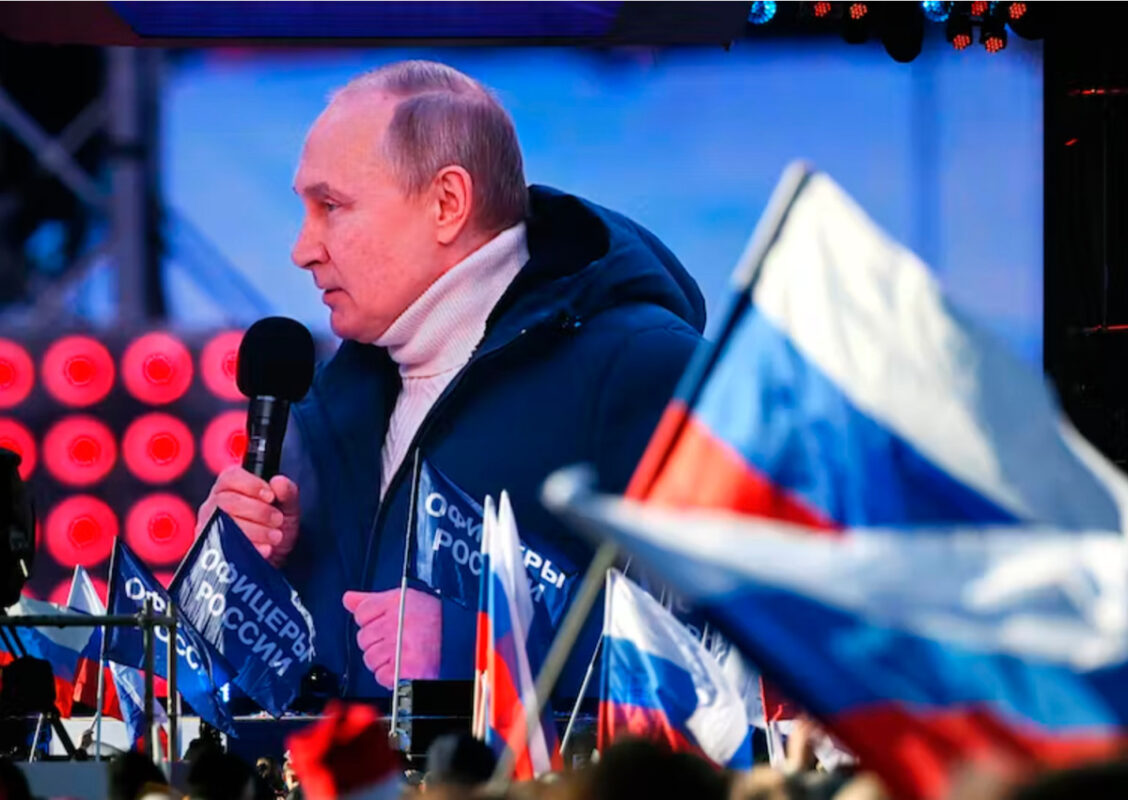
Vladimir Putin appears larger than life on screen as he addresses an audience at the Luzhniki Stadium in Moscow on the eighth anniversary of the annexation of Crimea in March 2022. Photo: Vladimir Astapkovich / Sputnik
By denying themselves Russian oil and to a lesser extent gas, European countries contributed to an increase in oil and gas prices that has buoyed the Russian coffers.
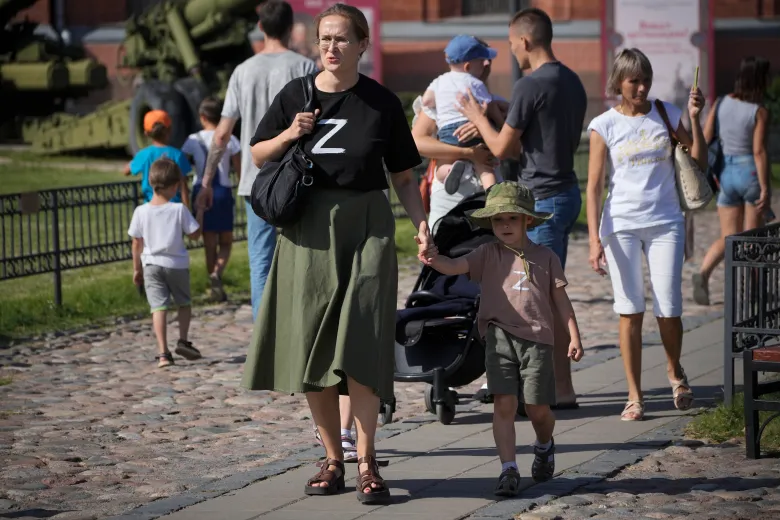
A woman and her child wear T-shirts with the letter Z, which has become a symbol of support for the Russian military, as they walk on the grounds of the Artillery Museum in St. Petersburg, Russia, August 2022. Photo: AP / Dmitri Lovetsky / The Conversation
Western commentators have also suggested that, simmering beneath the opinion poll numbers, there is latent opposition to Putin that isn’t being expressed because of fear. At the same time, there have been arguments that the Russian population is subject to a barrage of pro-Kremlin propaganda and therefore unable to really question the status quo.
There are good reasons for this beyond fear. First of all, many Russian oligarchs and political leaders are closely bound to Putin through a system of patronage that is deeply entrenched. Without Putin, they are likely to lose much of their wealth and status.
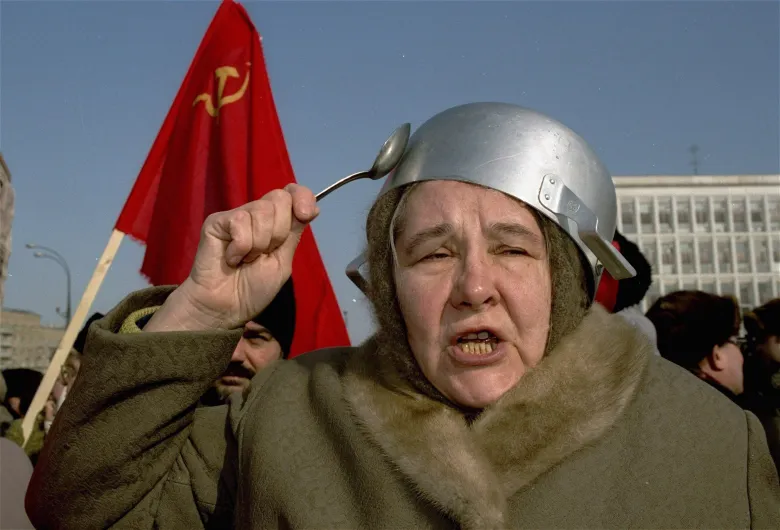
In this March 1993 photo, a woman in Moscow strikes a saucepan on her head with a spoon while shouting anti-Yeltsin slogans during a Women’s Day protest march against the cost of food. Photo: Alexander Zemlianichenko /AP
During the Yeltsin era, Russia seemed to be joining the Western liberal fold, but for many, that brought only economic pain and disorder. Not only was Russia a second-class power on the world stage, but the benefits of economic and political liberalization seemed to lack substance.
I spent some time in the city of Podol’sk near Moscow during the second financial crash of 1998 as hyperinflation destroyed savings and made many imported goods unaffordable. A sort of fatalistic anger was a common response to yet another economic blow.
Shortly after the 1998 financial crash, Yeltsin helped bring Putin to power as acting president at the end of 1999. An unlikely successor for Yeltsin in terms of his political profile, I didn’t expect much to change under Putin.
At first, Putin’s policies were similar to Yeltsin’s.
Nonetheless, by the time I visited Russia for the first time in several years in 2015, I could feel a palpable change in mood since my last visit. Not only was there greater order and cleanliness on the streets, but also a growing feeling of self-confidence in the Russian capital.
Putin the strongman had brought a degree of order after the chaos, and many Russians welcomed it even though a number of democratic elements of the Yeltsin regime disappeared. Western-style liberalism had not offered most Russians the sort of life promised to them by proponents of reform as the Soviet Union collapsed.
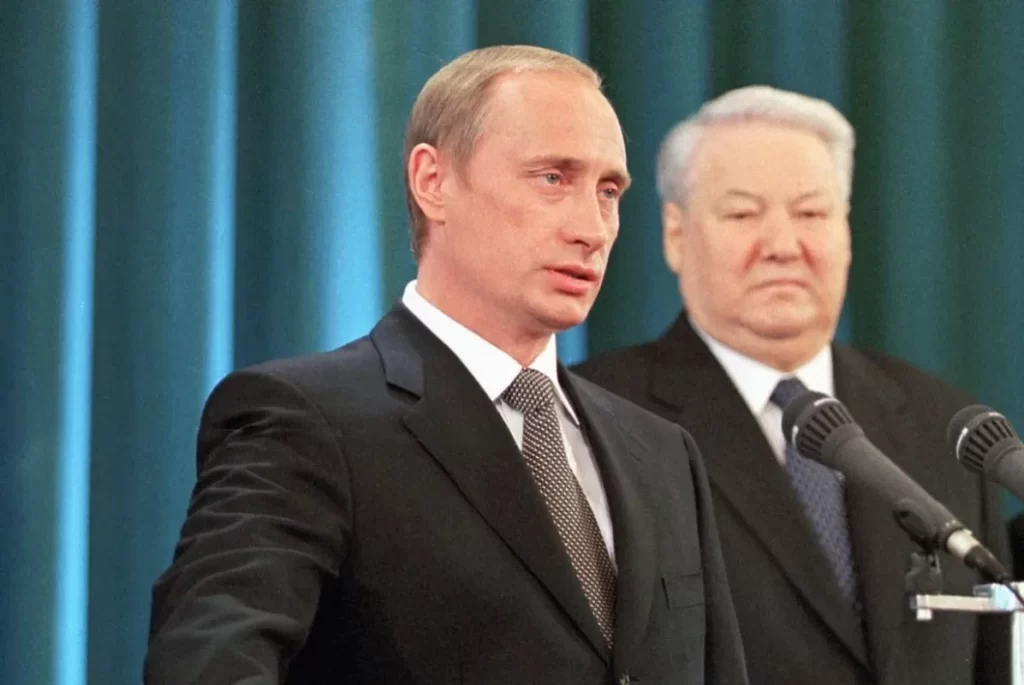
Regime change: Vladimir Putin takes the presidential oath beside Boris Yeltsin, in Moscow in May 2000. Photo: Wikipedia
Even today, evidence suggests many Russians — including those born after the Soviet Union’s collapse — value many things before democracy and Western political liberalism. The relative economic stability and order provided under the Putin regime have had widespread appeal.
Western sanctions have undoubtedly hit many Russians. However, the blanket and unprecedented nature of Western sanctions — and Western hypocrisy in its treatment of Russia — feed into Putin’s narrative that the West wants to keep Russia down.
The West has made it easy for Putin to claim to be a defender of Russian interests.
In the absence of obvious alternatives to Putin, only his health is likely a significant potential threat to his rule at the moment, and recent speculation about his ill health seems to be based on little or no meaningful evidence.
As far as we can reasonably tell, Putin is here to stay.
Donald Trump Should Not Repeat Woodrow Wilson’s Failure
April 30th is an important date in American politics. This is the day 100 for the American President in the White House, and all attention will be on the reports of his achievements and failures. But nothing can be more critical than Peace…
○
6 mins read
A Holocaust perpetrator was just celebrated on US soil. I think I know why no one objected.
Russia’s invasion has made ordinarily outspoken critics of antisemitism wary of criticizing Ukrainian Nazi collaborators
○
1 min read
Qi Book Talk: The Culture of the Second Cold War by Richard Sakwa
Richard Sakwa has for many years been one of the most distinguished and insightful observers of relations between the West and Russia, and one of the leading critics of Western policy. In this talk with Anatol Lieven, director of the Eurasia program at the Quincy Institute, Sakwa discusses his book, The Culture of the Second Cold War (Anthem 2025). The book examines the cultural-political trends and inheritances that underlie the new version of a struggle that we thought we had put behind us in 1989. Sakwa describes both the continuities from the first Cold War and the ways in which new technologies have reshaped strategies and attitudes.