Ukraine has agreed to a United States proposal of a 30-day ceasefire in its war with Russia following talks with United States officials in Saudi Arabia.
Military cadets march during the Victory Day military parade at the Palace Square in St. Petersburg, Russia, in May 2024, marking the 79th anniversary of the end of the Second World War. (AP Photo/Dmitri Lovetsky)
Russian officials say they are awaiting further details before making a decision on whether to accept the ceasefire. But it’s unlikely Russia will agree to a ceasefire without something concrete on the table in its favour first.
Few analysts would argue today that Ukraine is winning the war. Russia has the upper hand militarily, even if that has not translated into dramatic battlefield successes. Nonetheless, the threat of the Ukrainian position in the Kursk region collapsing is now very real.
Among Ukraine’s western backers, political will to continue the war appears to be waning. Trump argues it’s time for Ukraine to cut its losses and negotiate an end to the war. Such a deal would likely ultimately mean acknowledging Crimea as part of Russia, and some level of acceptance of Russian control over much of the Donbas.
There has been much discussion in the West on Ukrainian resilience in the war. Very little has however been written about Russian resilience — whether on the battlefield or in wider Russian society.
In the recently published Routledge Handbook of Soviet and Russian Military Studies, colleagues and I examine how the Soviet and Russian armed forces have developed over time from the Napoleonic Wars of the 19th century to the war in Ukraine.
From relatively early in the war, Russian polling data indicated President Vladimir Putin has had support from a clear majority of the Russian population. This support has certainly been helped by the fact that much of Russia’s population has been kept from experiencing the full economic and human costs of war.
People walk at Red Square in Moscow, Russia, in January 2025. Russia’s population has in the main been kept from experiencing and seeing the full economic and human costs of war. (AP Photo/Pavel Bednyakov)
The Russian economy has played a large part in sustaining Russia’s war effort. Despite western sanctions and high inflation, the economic outlook remains fairly strong.
According to Russia’s Federal State Statistics Service, GDP growth was reported as 4.1 per cent for 2024, albeit fuelled to a large extent by military spending.
Other than inflation, most key economic indicators are positive. Unemployment rates reached post-Soviet lows in mid-2024, and have subsequently dropped to around two per cent.
Where Ukraine relies mostly on conscription, Russia has been increasingly reliant on volunteers for its armed forces. The death or injury of volunteers is far less likely to have a negative impact on wider morale than the death of conscripts.
Russia began the war in Ukraine in February 2022 with an inadequately sized force given its unrealistic objectives. The initial plan to seize Kyiv was overly ambitious for the forces committed. However, after Ukrainian counterattacks in the fall of 2022, not only did Russia commit more adequate resources to the war, but gave them operational aims that suited their capabilities.
In this photo taken from video released by the Russian Defense Ministry in July 2024, Russian soldiers operate a 2S7M Malka self-propelled gun at an undisclosed location. (Russian Defense Ministry Press Service via AP)
The Russian armed forces have historically placed emphasis on the value of — and breaching of — fortified defensive positions. These strengths have been apparent not only in blunting the Ukrainian counteroffensive in the summer of 2023, but also in the subsequent, often successful, co-ordination of small infantry storm detachments with drones to take Ukrainian defensive positions.
While the Russian army remains a relatively blunt instrument, it is not as blunt as it was in late 2022 and early 2023.
This more methodical approach certainly contrasts strongly with both the almost reckless Russian advance at the very beginning of the war on the Kyiv axis — and indeed the squandering of lives by the Wagner Group in early 2023. Credible sources are no longer suggesting that the sort of losses suffered by troops from the Wagner Group in taking Bakhmut in May 2023 are still being suffered by Russian forces today.
Using new technology
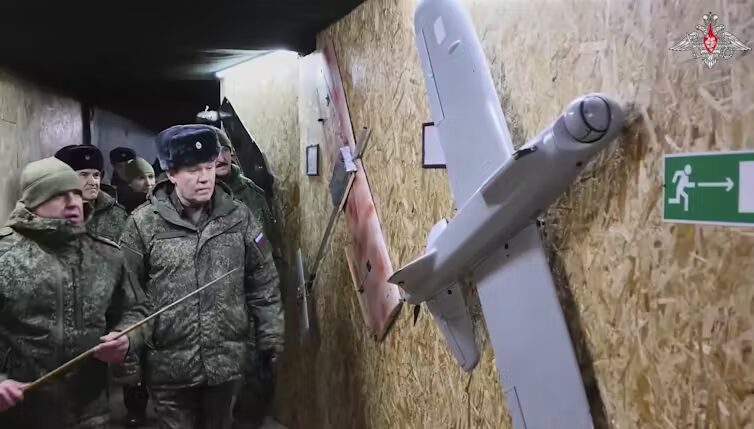
The Russian military has also been making use of new technologies as the war has progressed. The Soviet and Russian armed forces have a long history of embracing new technology. While at times they have been slow to do so, when they do, they adopt that technology en masse and with enthusiasm.
In this photo taken from video released by Russian Defense Ministry Press Service on Feb. 28, 2025, Russian Chief of General Staff Gen. Valery Gerasimov (right) examines a display of military equipment during an inspection of troops at an undisclosed location in Ukraine. (Russian Defense Ministry Press Service via AP)
What this could mean of negotiations
Any lasting deal Ukraine could make with Russia in the near future is likely to be far worse for Ukraine than the sort of deal that was being discussed back in the spring of 2022. Regardless of one’s perspective on the conflict, such a situation appears inevitable given battlefield realities.
However, renewed negotiations may stand a higher chance of securing a sustainable peace in the near future. Given heavy losses on both sides, both Russia and Ukraine will be heavily invested in seeking a lasting deal.
Alexander Hill does not work for, consult, own shares in or receive funding from any company or organisation that would benefit from this article, and has disclosed no relevant affiliations beyond their academic appointment.
The details of the peace deal presented today by US special envoy Steve Witkoff are consistent with the report in the Financial Times discussed in my previous article and with Larry Sparano in the posted interview. Putin will halt the Russian advance prior to driving Ukrainian soldiers out of all of the territory that has been reincorporated into Russia. It appears to be the case that the borders between Russia and Ukraine will be the current front line, so Putin is withdrawing Russia’s claim to the Russian territories still under Ukrainian occupation.
Russia and the US seem near a Ukraine peace deal. Kyiv’s role may be moot.
President Donald Trump’s hopes of securing a quick Ukraine peace deal hang in the balance after Washington’s envoy, Steve Witkoff, held his fourth Kremlin meeting with Russian President Vladimir Putin Friday.