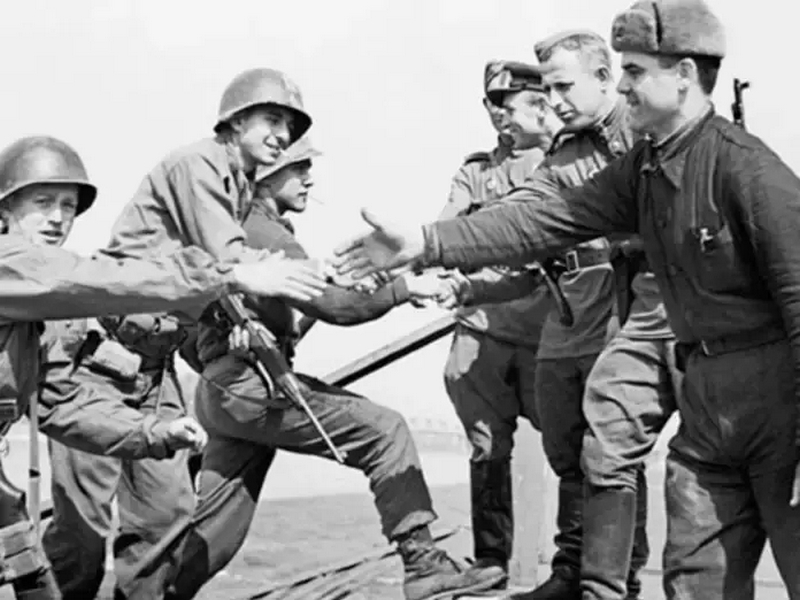
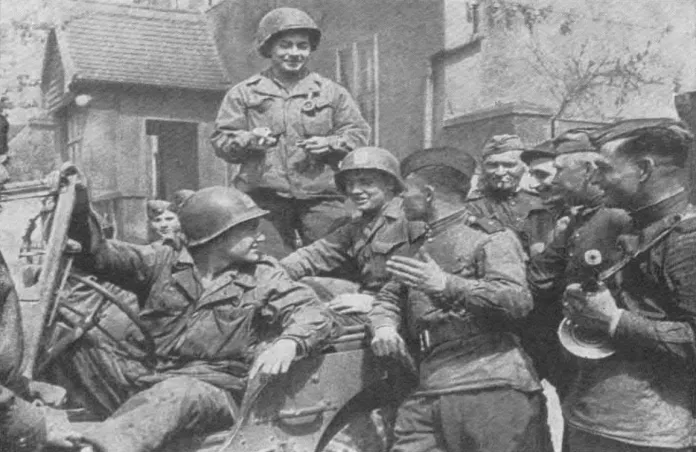
April 25 marked the 77th anniversary of the “Oath of the Elbe,” when U.S. and Russian soldiers embraced in a historic meeting on the Elbe River in Torgau, Germany, to mark the final end of the Third Reich and pledge mutual understanding, empathy and peaceful relations between the U.S. and Soviet Union
U.S. and Soviet troops embrace on the Elbe River on April 25, 1945, to celebrate their defeat of Naziism.
Despite today’s hysterical hostility towards Russia—fomented by U.S. corporate interests, implemented by opportunistic politicians, and enflamed by a complicit mass media—the Russian and American people have a long tradition of friendship and mutual support.
A Suppressed History
Long forgotten is a history of U.S.-Russian cooperation that goes back to the era of Catherine the Great who supported the American revolution.
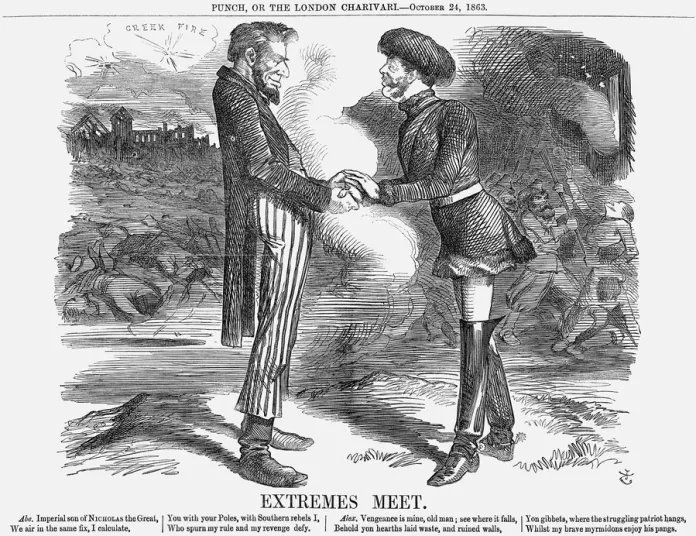
Russia returned the favor during the American Civil War (1861-1865), when Abraham Lincoln called for Russian help because Great Britain and France began supporting the Southern Confederacy in an attempt to destabilize and weaken the United States.
Cartoon depicting Abraham Lincoln and Russian Czar Alexander II shaking hands as fighting rages all around them. [Source: usrussiarelations.org]
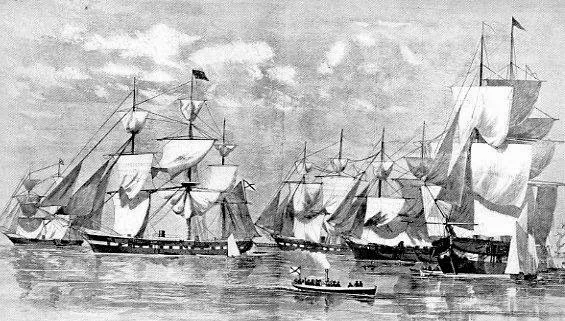
The Russians sent the Imperial Navy’s flagship, Alexander Nevsky, along with four other vessels into New York harbor four days after the Union defeat at the Battle of Chickamauga as a warning for the British and French to back off—which they did.
Russian Imperial Navy’s flagship, Alexander Nevsky, sailing into New York harbor as depicted in Harper’s Weekly.
Secretary of the Navy Gideon Welles wrote in his diary afterwards: “God Bless the Russians,” while future Supreme Court Justice Oliver Wendell Holmes, Jr., a Union army lieutenant, wrote a song about “the nation who was our friend when the world was our foe.”
In Lincoln and the Russians (1952), historian Albert A. Woldman wrote:
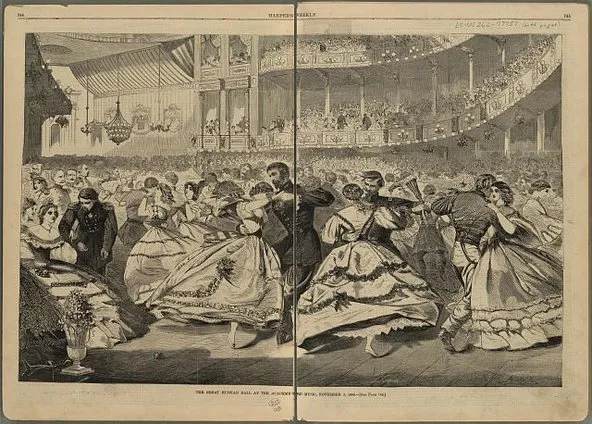
“New York City, gaily bedecked with American and Russian flags, bubbled over with sumptuous hospitality for the Muscovite naval officers wearing gold laced chapeaux [who] were cheered as they were being driven up Broadway. The city’s merchants and businessmen gave a banquet in their honor at the Astor House and there was a Grand Ball for the officers at the Academy of Music [which] according to the editor of Harper’s Weekly was undoubtedly the greatest ball every given in this country, with excepting the ball to the Prince of Wales.”
Great Russian Ball at the Academy of Music, November 5, 1863. The tables were decorated with the likenesses of Washington and Peter the Great, of Lincoln and Czar Alexander. Harper’s Weekly referred to the Russians as “Slavic heroes,” and described the Ball as a “very wonderful and indescribable phantasmagoria of humanity.”
Harper’s Weekly specified that the feting of the Russian sailors had “a political significance….Every [U.S.] citizen felt bound to do what in him lay to testify to the Russians our sense of gratitude for the friendly manner in which Russia has stood by us in our present struggle, while the Western powers have done not a little to work our ruin.”[4]
How quickly we forget!
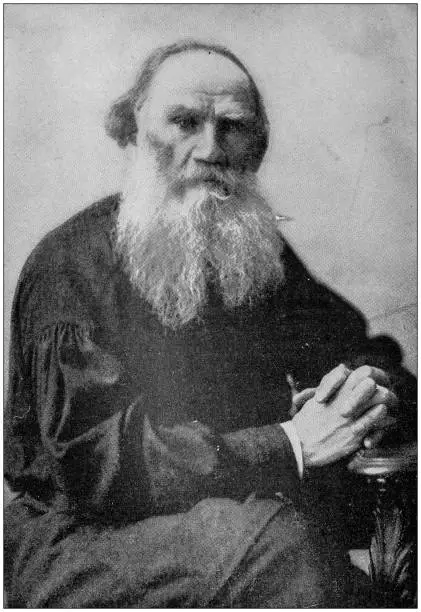
Lincoln was generally a visionary who understood the benefits of close diplomatic relations with the Russians. The great man of letters, Leo Tolstoy, praised Lincoln as “a man of whom a nation has the right to be proud; a Christ in miniature, a saint of humanity whose name will live thousands of years in the legends of future generations.”
Leo Tolstoy
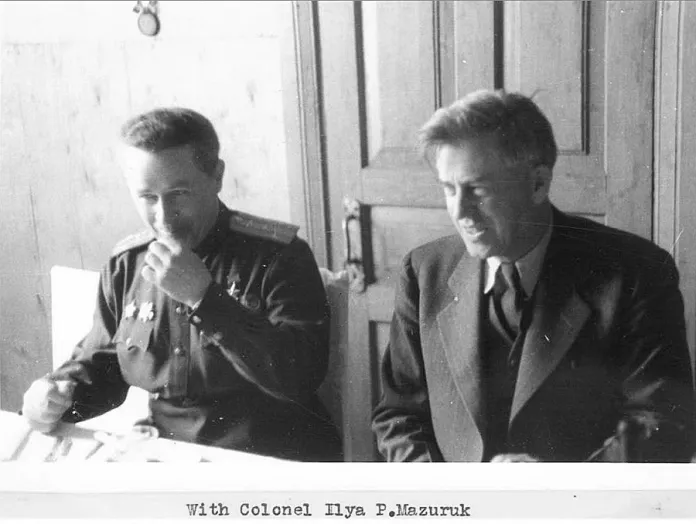
Tolstoy would have had similar high regard for Franklin D. Roosevelt and his Vice President Henry A. Wallace (1941-1945), who would almost certainly have embraced and implemented the Elbe spirit. But any such possibility was sabotaged when Wallace was ousted from the vice-presidency at the 1944 Democratic Party convention in Chicago in a coup and replaced with Harry S. Truman, who betrayed Roosevelt’s legacy as president by starting the Cold War.
Henry Wallace with Russian Colonel Ilya P. Mazuruk in Moscow in May 1944 at the height of cooperation in the anti-fascist war.
Of course, none of the above ignores the reality that the Russian-U.S. relationship has not always been ‘wine and roses.’
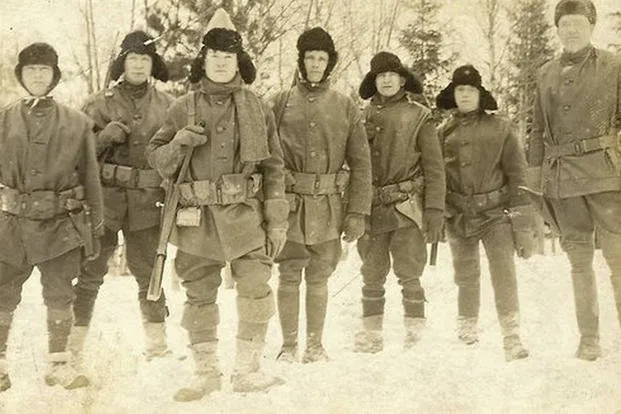
Toward the end of WW I, U.S. President Woodrow Wilson joined with Britain, France and Japan to launch a military invasion of Russia that included 8,500 American soldiers. It was originally intended to block the German war effort, but after the 1917 Russian Revolution, the Allied forces stayed on until 1920 in a futile attempt to overthrow Russia’s Bolshevik government.
U.S. soldiers in Siberia in 1918 in an ill-fated invasion designed to overthrow the Bolsehvik revolution.
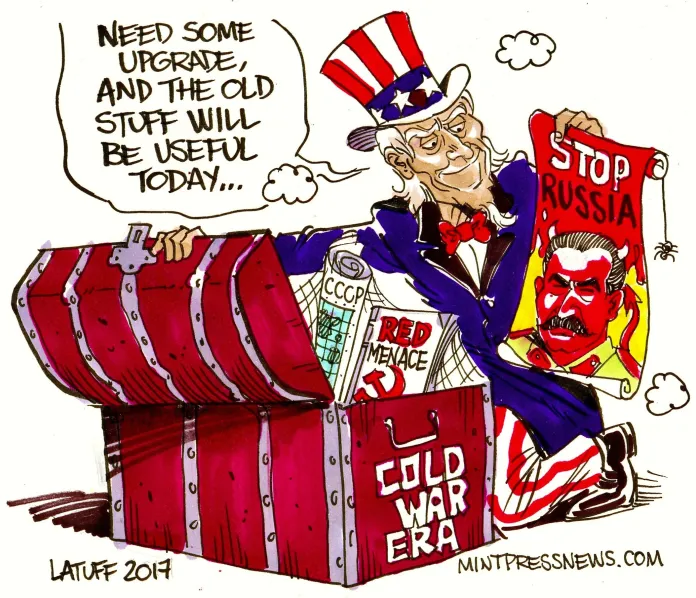
And after World War II, U.S. government propaganda cynically transformed Russia into a threatening demon to justify the transformation of America into a permanent military economy for the enrichment of the military-industrial complex.
Nevertheless, it would be a good idea if the lost history of U.S.-Russian cooperation were to be remembered at this dark historical moment, since the fate of the world may depend on it.
Joseph Polowsky and the Elbe River Spirit
A person with his own private reason for remembering this history of Russian cooperation was a Chicago taxi driver named Joseph Polowsky.
Every year on April 25, prior to his death from cancer in 1983, Polowsky would stand on the Michigan Avenue bridge and pass out leaflets calling for a halt to the spread of nuclear weapons and Cold War.
When approached by passersby, he would tell them about the historic meeting between American and Russian soldiers at the end of World War II, along the Elbe River in Central Europe.
Polowsky didn’t just know the details of the meeting, which marked a crucial step toward the end of the war, he had taken part in it.
Joe Polowsky featured standing above army jeep.
Today, Polowsky’s son, Joseph Wolff, is carrying on the tradition and spirit of the Elbe River meeting.
On the seventy seventh anniversary of the linkup, Wolff, called for a renewal of the Elbe River oath at a commemorative Zoom event.
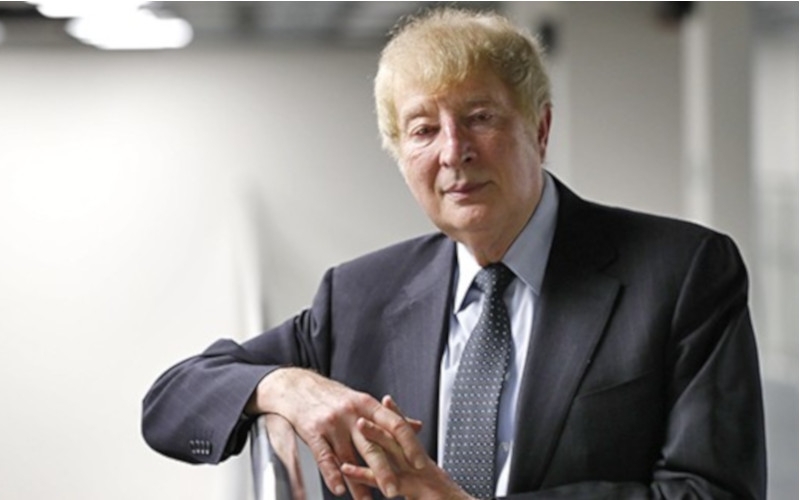
Edward Lozansky
The event was sponsored by the Eurasian Peoples’ Assembly and Edward Lozansky, founder and president of the American University in Moscow (now Moscow International University), who has long promoted U.S.-Russian friendship.
Wolff reminded the audience that the meeting between U.S. and Soviet troops on the Elbe River on April 25, 1945, marked the end of the Third Reich.
The troops made a pledge for mutual understanding, empathy and peaceful relations between the U.S. and Soviet Union which, Wolff said, his father worked for for the rest of his life.
Today, with U.S.-Russian relations at a breaking point, Wolff said that the time to renew the Elbe oath is now.
“The threat of World War III is real and the stakes are too high,” he said. “With the conflict in Ukraine, the threat from the pandemic and climate change, the world needs the U.S. and Russia to work on the same team.”
“All of us are part of one race, the human race. We need to set our grievances aside and have our two great nations work together for the human race to flourish for hundreds of years into the future.”
Despite the strenuous efforts by Biden and his surrounding coterie of war hawks and imperialist profiteers to paint Russia as a fearful enemy seeking world conquest, perhaps the spirit of Polowsky and the Elbe River oath might yet prevail if people mobilize in support of it.
Remembering Edward Lozansky, Towering Prophet of Sanity, Decency and Peace
Soviet and American physicist and political figure Edward Lozansky dies in Moscow, on April 30, 2025.
Edward Dmitrievich Lozansky was born in Kiev on February 10, 1941. He graduated from the Kurchatov Institute of Atomic Energy with a degree in theoretical nuclear physics. He was a researcher at the Kurchatov Institute of Atomic Energy and the Joint Institute for Nuclear Research in Dubna. At the same time, he taught at the Malinovsky Armored Forces Academy.
In 1976, he moved to the United States, became a US citizen, and lived in Washington, DC. In 1990, he founded the American University in Moscow (now Moscow International University).
In recent years, he actively participated in the work of the Assembly of the Peoples of Eurasia and Africa and was the US moderator of the international public forum “The Spirit of the Elbe: A Bridge of Trust, Friendship, and Cooperation,” which was held with great success on April 15, 2025. A word of remembrance from Martin Sieff, joined by the entire editorial staff of the Pluralia project.
○
2 mins read
Open Appeal to Presidents Trump and Putin
We kindly invite you to review and sign the Open Appeal to President of the United States Donald Trump and President of Russia Vladimir Putin
○
1 min read
International Forum “Spirit of the Elbe: A Bridge of Trust, Friendship, and Cooperation”
The organizers of the International Forum “Spirit of the Elbe: A Bridge of Trust, Friendship, and Cooperation” invite media, public figures, and representatives of culture, science, and business to participate in a landmark event taking place on April 15, 2025. The Forum will be held in a hybrid format: in-person at the Conference Hall of the Assembly of the Peoples of Eurasia in Moscow and via Zoom conference (up to 200 participants, approximately evenly split between Russia and the USA). The event begins at 5:00 PM Moscow time (10:00 AM Washington, D.C. time).