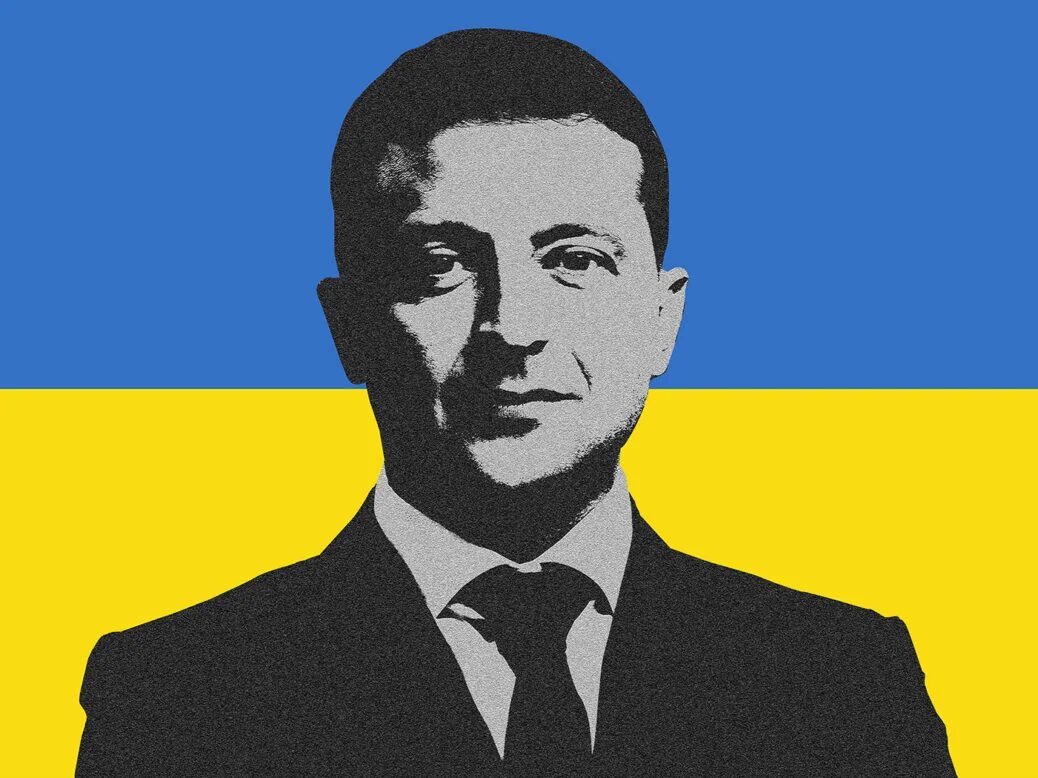
Ukrainian President Volodymyr Zelensky has, in the context of the tragic conflict now raging in his country, been propelled from the most unlikely leader of a country mired in corruption with a parlous economy into something approximating to Marvel superhero, doughtily defending Ukraine against an implacable Russian bear in the cause of Western values of democracy, human rights, the rule of law and, well, by now we all know the script.
His near deification in the West has seen him give address teary-eyed parliamentarians and congressmen and women across Europe, North America and the Antipodes by video link; the embattled president regaled in khaki while regaling his audiences with a stentorian message of resistance during which he has mined WWII analogies by the dozen. Specifically, he has drawn comparison with Ukraine’s resistance to Russian aggression with Hitler’s invasion of Poland, reminded his British supporters in particular of Churchill’s legacy, his American supporters of Pearl Harbor, and his German supporters of the Berlin Wall — all with the objective of evoking the kind of emotional response that should send a chill down the spine of every right thinking person who understands well the warning sounded by Emma Goldman, when she once famously declared: “It [the mass] clings to its masters, loves the whip, and is the first to cry Crucify!”
We today are living through a time of the “mass spirit” of which Goldman cautioned, a time when critical thought has been supplanted by a collective lust for blood — Russian blood, Putin’s blood — with the latter ordained as the new Hitler and upon which is being projected unalloyed hatred as the human repository of pristine evil in our time.
Zelensky, in this reductive scenario, allows us to retain a sense of innocence as citizens of a Western ideal, stretching back to the Enlightenment, which holds that our cultural values are rooted in progress and justice and that whenever we have dropped bombs, launched missiles, invaded other countries and been the cause humanitarian crises, it has been in the name of civilisation and human progress and, as such, a price worth paying (Madelein Albright anyone?) for us as well as ‘them’.
Zelensky’s by now iconic appearances by video link, his branding as a wartime leader we can get behind, bears all the hallmarks of theatrical performance, tapping into the myths that we have — all of us — been conditioned to believe about ourselves and about those deemed to exist on the other side of the ideological circle of human worth established in the name of Western exceptionalism.
The great Bertolt Brecht, it was, who made the point that ‘Unhappy the land that is in need of heroes’, which in today’s context is certainly applicable to the West.
Indeed, Western society has never been more unhappy in this age of late stage capitalism; what with brute inequality and poverty normalised to a never seen before degree; what with the lack of meaning other than that provided by Netflix, Instagram and gaming; and what with celebrity culture having replaced real culture as the acme of ideas and identity.
The cumulative effect has been societal and cultural anomie, a collective melancholy exacerbated by Covid, and the concomitant atomisation of Western society into a disorganised mass of human dust.
Mr Zelensky, seen from this perspective, has assumed the mantle of saviour not only of Ukraine but of ourselves, giving us a hero to worship and live through vicariously, stirring long buried feelings of togetherness and greatness in the epic struggle between good and evil, darkness and light, progress and regress that every generation — if lucky, we are taught — experiences at least once.
Nothing binds us to our slavemasters more than an external monster. Then we become the most ardent patriots and defenders of the very status quo that has crushed our communities, hopes and futures in the name of good governance.
Zelensky’s representation as a great leader is a work of fiction through which a greater truth is being told. This greater truth is that a West in decline is reduced to spectating at the consequences of that decline — the desperate attempt to maintain the hegemony it has enjoyed as the one indispensable culture and ideological bloc measured hitherto in a trail of carnage and chaos — in the form of the conflict in Ukraine.
Indeed, just like spectators at the Coliseum in Rome, we are watching unfold the game of war, revelling in the escape it has afforded us from lives of unremitting monotony and mundanity, finding renewed purpose in the simplified rendering of a conflict by a political and media class that has conditioned us to believe that we in the West have a monopoly on truth, morality and decency.
How fitting that a man who began his career as an actor before entering politics, without any qualifications for the role of president of a country other than the fact he had none, should find himself being feted by Hollywood for the greatest and most performance any actor could ever undertake — that of a wartime leader carrying the hopes and dreams of an entire civilisation into battle.
He is Nietzsche’s superman come to life, the embodiment of Carlyle’s great man theory, and thereby fated to disappoint. His country in ruins and his name in lights, Mr Zelensky’s place in history is already assured.
Meanwhile, as the rest of us return to the dull familiarity of routine when the shooting stops — and as Zelensky embarks on a world tour of staterooms and parliaments to be anointed in person and lavished with gifts and garlands — Ukrainian mothers will get on with the business of mourning and burying their sons.
The details of the peace deal presented today by US special envoy Steve Witkoff are consistent with the report in the Financial Times discussed in my previous article and with Larry Sparano in the posted interview. Putin will halt the Russian advance prior to driving Ukrainian soldiers out of all of the territory that has been reincorporated into Russia. It appears to be the case that the borders between Russia and Ukraine will be the current front line, so Putin is withdrawing Russia’s claim to the Russian territories still under Ukrainian occupation.
Russia and the US seem near a Ukraine peace deal. Kyiv’s role may be moot.
President Donald Trump’s hopes of securing a quick Ukraine peace deal hang in the balance after Washington’s envoy, Steve Witkoff, held his fourth Kremlin meeting with Russian President Vladimir Putin Friday.