Russia’s budget revenue rose to a record high last month even after the US targeted the banking sector with a new round of sanctions aimed at disrupting foreign trade payments and curbing proceeds from exports.
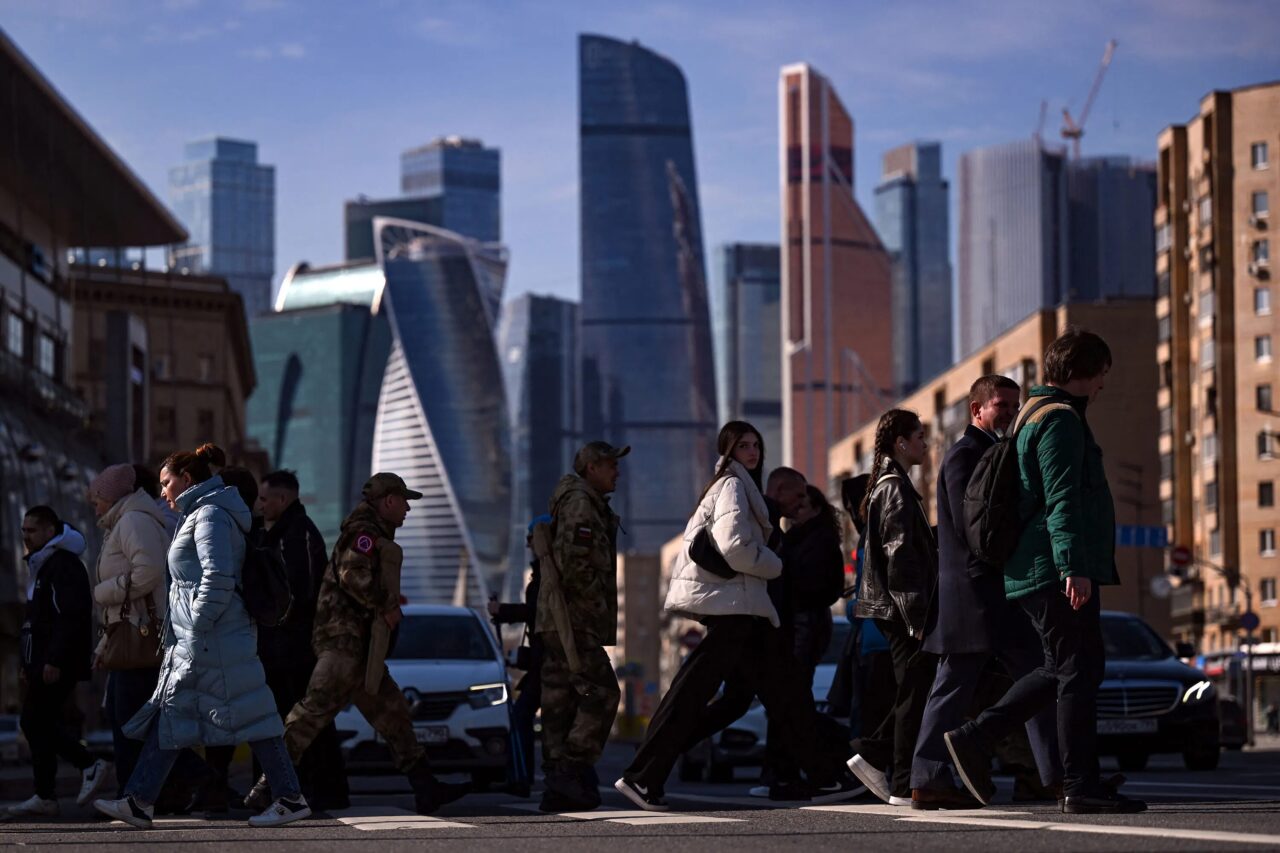
Moscow's business district.Photographer: Natalia Kolesnikova/AFP/Getty Images
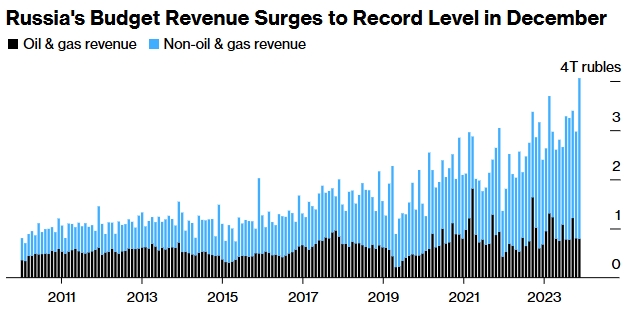
Total revenue in December reached more than 4 trillion rubles ($40 billion), up by 28% compared with the same month of the previous year, according to Bloomberg calculations based on Finance Ministry data published late Monday. That’s the highest level recorded in ministry data that starts from January 2011.
Source: Russian Finance Ministry, Bloomberg
The US and its allies have been seeking to stop the Kremlin’s war machine by limiting export revenues and imposed more sanctions on Russia’s energy industry and banks that service it late last year. That triggered a collapse in the ruble and depressed Russia’s foreign trade in December. Exports dropped by 19% last month compared to the previous year, and imports shrank by about 8%, according to central bank data published on Tuesday.
Still, oil and gas income spiked by a third in December from the previous year and increased by 26% for 2024, according to the Finance Ministry, while other sources of revenue posted a similar advance for the full year due to taxes and dividends amid robust economic growth.
“The volume of non-oil and gas revenues in 2024 significantly exceeded estimates in the 2025-2027 budget law, including from the largest tax sources,” the Finance Ministry said in a statement.
The increase in revenue allowed the government to spend more than ever, with total expenditure for the month of 7.15 trillion rubles, breaching the previous record set in December 2022.
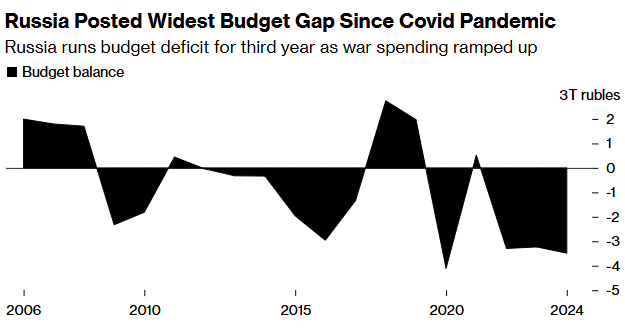
Russia last year posted its widest fiscal gap since the Covid pandemic in 2020 at 3.5 trillion rubles or 1.7% of gross domestic product. The government ran a budget deficit for a third year as President Vladimir Putin’s February 2022 invasion of Ukraine led to huge increases in state spending on the military and measures to support domestic business amid sweeping sanctions.
Source: Finance Ministry
Total revenue in 2024 rose by 26% to 36.7 trillion rubles, while expenses increased by 24% to 40.2 trillion rubles. The Russian currency lost about 12% against the dollar in the period, according to central bank data.
The Kremlin continues to ramp up spending on the war as its forces slowly advance in Ukraine. About a third of its budget is expected to be spent on military needs in 2025, according to the budget law.
The budget’s execution in 2024 confirms doubts that a planned increase in spending this year of only 3.2% is realistic, according to Alfa-Bank.
“We expect that the growth in expenditures this year will be higher, leading to a larger budget deficit,” the bank’s analysts said in a note.
Donald Trump Should Not Repeat Woodrow Wilson’s Failure
April 30th is an important date in American politics. This is the day 100 for the American President in the White House, and all attention will be on the reports of his achievements and failures. But nothing can be more critical than Peace…
○
6 mins read
A Holocaust perpetrator was just celebrated on US soil. I think I know why no one objected.
Russia’s invasion has made ordinarily outspoken critics of antisemitism wary of criticizing Ukrainian Nazi collaborators
○
1 min read
Qi Book Talk: The Culture of the Second Cold War by Richard Sakwa
Richard Sakwa has for many years been one of the most distinguished and insightful observers of relations between the West and Russia, and one of the leading critics of Western policy. In this talk with Anatol Lieven, director of the Eurasia program at the Quincy Institute, Sakwa discusses his book, The Culture of the Second Cold War (Anthem 2025). The book examines the cultural-political trends and inheritances that underlie the new version of a struggle that we thought we had put behind us in 1989. Sakwa describes both the continuities from the first Cold War and the ways in which new technologies have reshaped strategies and attitudes.